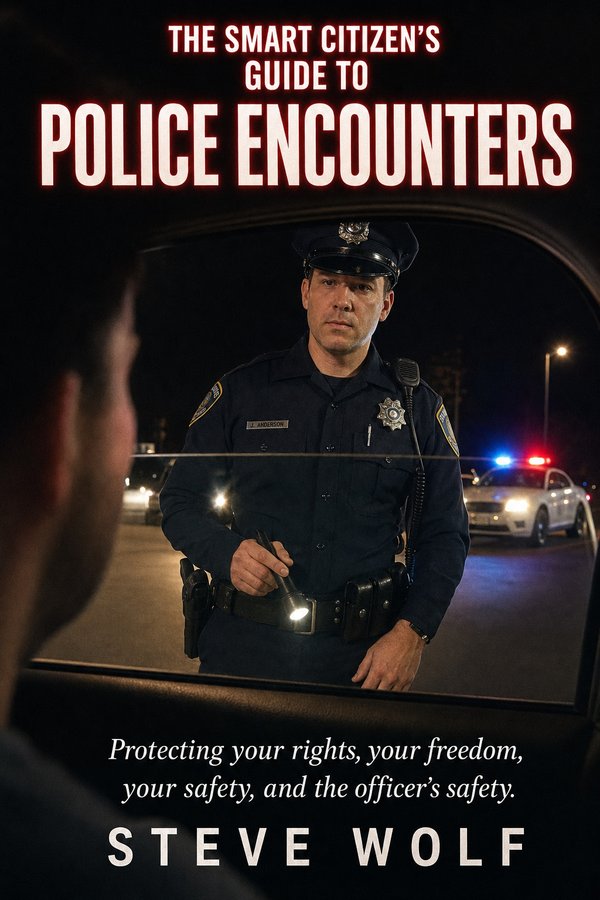
Tactical Choices · Steve Wolf
The Smart Citizen’s Guide to Police Encounters
Protecting yourself, your rights, and the officer who stops you
Copyright © Stephen Wolf, 2026
Front Matter
About the Author
❦
Steve Wolf has taught firearms and safety skills since 1994, to students ranging from movie stars to Special Weapons and Tactics (SWAT) team members. He has spent more than three decades coordinating stunts, special effects, and pyrotechnics on feature films, and he testifies as an expert witness in cases involving firearms, fire, explosives, rigging, and violent injury. He has been retained by prosecutors and by defense counsel, and he has sat across the table from police officers, detectives, and investigators in hundreds of matters.
That is the vantage point this book is written from. He has watched what people say to police become the evidence that convicts them. He has watched officers make decisions in two seconds that lawyers then argue about for two years. He teaches both sides, and he has no interest in flattering either one.
- Certified expert witness on firearms use
- State-certified handgun instructor
- National Rifle Association (NRA) Firearms Instructor Development School
- NRA Range Development School
- NRA Refuse To Be A Victim instructor
- NRA Youth Firearms Safety Training instructor
- Anti-crime driver training instructor
- Worked with Navy Special Warfare
- Worked with the United States Secret Service
- Advanced tactical pistol training
- Explosives entry techniques
- Explosives instructor, Special Effects International
- Host of the nationally syndicated radio show “Crime Talk”
- International Defensive Pistol Association ranked shooter
- Licensed private investigator
- Licensed explosive manufacturer
- Licensed pyrotechnician
- Emergency Medical Technician (EMT), first aid and cardiopulmonary resuscitation (CPR) instructor
- Licensed scuba instructor
- Special effects and stunt work on 77 feature films
Steve is the author of “The Smart Citizen’s Guide to Concealed Carry.” This book is its companion. The first one teaches you how to survive a criminal. This one teaches you how to survive the aftermath, and the ordinary Tuesday afternoon when a patrol car pulls in behind you.
Front Matter
A Note Before You Start
❦
I am not a lawyer, and this book is not legal advice. I am a trainer and an expert witness who has spent a career studying how encounters go wrong and what the record looks like afterward. What follows is safety instruction built on the published decisions of the United States Supreme Court and on the rules that officers are actually trained to follow.
Criminal procedure is federal at the floor and local everywhere above it. The Constitution sets the minimum you are owed in every state. Your own state and city can give you more, and many do. So can your state constitution, which several state supreme courts read more protectively than the federal one. Before you rely on any specific rule in this book, confirm it where you live, and confirm it again in every state you drive through.
Every case name in this book is real and every citation is checkable. Appendix E lists them. If a rule matters to you, go read the case. It will take you fifteen minutes and it will serve you better than any summary, including mine.
Standing advice
Find a criminal defense attorney before you need one. Program the number into your phone under a name you will find while your hands are shaking. The attorney who closed on your house is not the attorney for this.
Front Matter
Contents
❦
Chapter One
Reader Goals and Personal Responsibility
❦
By the end of this book you will be able to name the three kinds of police encounter and tell them apart; recite the exact words that preserve your rights; explain why silence alone does not protect you; and describe what to do with your hands, your voice, your phone, and your firearm from the moment you see the lights until the moment you are home.
What this book asks of you
A police encounter is a physical event with legal consequences. Both halves can kill you. The physical half can kill you in four seconds. The legal half takes longer and costs more, and it ruins far more lives.
Most people prepare for neither. They assume that being innocent is a plan. It is not a plan. Innocent people are shot during traffic stops. Innocent people talk themselves into indictments. Innocence is a fact about you. It is not a technique, and it is not visible from behind a flashlight at midnight.
The two failure modes
Everything that goes wrong in a police encounter falls into one of two buckets.
Failure one: you escalate. You argue. You reach. You move fast. You demand to know why. You have decided that this is the moment to litigate the Fourth Amendment on the shoulder of the highway, in the dark, with a stranger who is worried about getting home to his own family. You lose. Sometimes you lose everything.
Failure two: you cooperate yourself into a conviction. You are polite. You are helpful. You answer every question. You let the officer search because you have nothing to hide. You explain. Six months later a prosecutor reads your explanation to a jury, and the words you used to prove your innocence are the words that establish an element of the offense.
The whole craft is threading between those two failures. Total compliance with lawful commands. Total refusal to supply evidence. Those two things are not in tension, and this book is about how to do both at once.
Personal responsibility
You are responsible for your own hands. You are responsible for your own mouth. You are responsible for knowing the law in every jurisdiction you travel through, and for knowing the difference between what you are allowed to do and what is smart to do.
Nobody is coming to save you at the roadside. Not the Constitution, which is a document and not a force field. Not the officer, whose job is to investigate, not to protect your case. Not a bystander with a phone. You, your preparation, and your self-control are what is present.
Chapter One checklist
- Accept that innocence is not a strategy
- Decide now that you will comply physically and decline verbally
- Identify a criminal defense attorney and save the number
- Read your own state’s law, not just the federal rules
Chapter Two
Why This Book Exists
❦
There is a mountain of advice online about dealing with police, and a good deal of it is dangerous. It is dangerous in a specific and predictable way, and knowing that way helps you sort the good advice from the bad.
The internet teaches the courtroom and skips the roadside
Most of the popular material is made by people who are good at law and have never been in a fight. The advice is legally correct and physically suicidal. Roll your window down two inches and refuse to lower it further. Refuse to open your door. Announce that you do not answer questions, then keep driving. Demand a supervisor. Read the statute aloud.
Every one of those moves is lawful in some jurisdiction. Several of them will get you extracted through a car window. The advice is written as though the officer were a search engine that returns a legal result when you type the right query. He is not. He is a human being under stress, who has been told at four roll calls this month about officers killed on traffic stops, and who is watching your hands.
The other half teaches compliance and skips the consequences
The mirror-image failure comes from people who tell you to just cooperate and it will be over faster. That is true right up until it is not. Consent to a search is the single most common way that ordinary people generate the evidence used to convict them. A person who says yes has surrendered a protection the government could not have taken by force without a warrant.
What actually kills people, and what actually convicts them
What kills people and what convicts them are two different lists, and confusing them is why the advice is so bad.
| Risk | What drives it | What defends against it |
|---|---|---|
| Physical harm during the encounter | Sudden movement, hands out of sight, reaching, arguing, closing distance, non-compliance with a command | Slow hands, announced movements, immediate compliance with commands, calm voice |
| Legal harm after the encounter | Answering questions, consenting to searches, explaining, guessing, apologizing, unlocking your phone | Clear invocation of rights, refusal of consent, silence, an attorney |
Look at the two right-hand cells. Nothing in one conflicts with anything in the other. You can put your hands on the wheel and decline a search in the same breath. You can step out of the car when told and say nothing on the way. The mistake people make is thinking they must choose.
The goal is a boring encounter
You are not trying to win. There is nothing to win at the roadside. Every remedy you have, suppression of evidence, dismissal, a civil suit, a complaint, exists somewhere else, on a later date, with a lawyer. The roadside has no remedies in it. It has only outcomes.
What you want is the most boring three minutes of that officer’s shift, and a record afterward with nothing in it that hurts you.
Chapter Two checklist
- Sort every piece of advice you hear into physical risk or legal risk
- Reject any advice that trades your safety for a legal point
- Reject any advice that trades your case for a faster stop
- Aim for boring, not for victory
Chapter Three
The Officer’s Side of the Encounter
❦
You cannot manage a person whose situation you do not understand. For three minutes, stop thinking about your rights and think about what the man walking up to your window actually knows, which is close to nothing.
He does not know who you are
He has a plate, and the plate tells him about a registered owner who may or may not be driving. He may see a stale record with a flag on it. He does not know whether you are a schoolteacher or the subject of a warrant three states away. Everything he does in the first thirty seconds is designed to settle which one you are without getting hurt.
This is why he stands behind your door pillar. This is why he touches your tail light. This is why he asks you questions he already knows the answers to, and watches how you answer them.
He is running on the same physiology you are
Under a real adrenaline dump, human beings lose fine motor control, lose peripheral vision, lose accurate time perception, and lose hearing. I teach this to shooters. It applies to the person in the uniform exactly as it applies to you. An officer who has decided you might be a threat is not going to reason his way back out of that decision quickly, because the chemistry does not permit it.
Which means: your job is to keep him from ever making that decision. Everything in this book about hands and movement exists for that one purpose.
What he is trained to watch
- Your hands, before your face
- Movement toward the waistband, the console, the glovebox, under a seat
- Furtive motion while he approaches, which reads as hiding or reaching
- Sudden changes in your speed of movement
- The number of occupants and where their hands are
- Whether your story changes
Notice that most of that list is physical. Only the last item is verbal. That tells you where your attention belongs in the first minute.
He is also building a case
The friendly conversation is not small talk. “Where are you headed tonight?” is an investigative question, and Chapter Eleven explains what it is for and how to answer it. “Do you know why I stopped you?” invites you to confess to a violation the officer may not have been able to prove. “You don’t have anything in the car I need to know about, do you?” is the first step of a consent search.
None of that is dirty pool. It is the job. An officer is permitted to ask, permitted to be friendly, and, during questioning, permitted to lie to you about the evidence he has. Understanding that he is doing his job is what allows you to do yours without getting angry about it.
Two things that are true at once
The overwhelming majority of officers will treat you decently and send you on your way. That is true. It is also true that you cannot tell in advance which kind of officer you have, and that a decent officer with bad information can still put you in handcuffs. Prepare for the encounter, not for the person.
Worth knowing
The Supreme Court has held that an officer’s reasonable mistake about the law can still support a valid stop. Heien v. North Carolina, 574 U.S. 54 (2014). An officer who pulls you over for something that turns out not to be illegal has not necessarily done anything wrong, and the stop stands. Arguing that he is mistaken does not end the encounter.
Chapter Three checklist
- Assume he knows nothing about you and is watching your hands
- Never make a movement he has not been told to expect
- Treat every friendly question as an investigative question
- Do not take his suspicion personally, and do not argue with it
Chapter Four
The Three Kinds of Encounter
❦
This is the chapter that makes the rest of the book work. Everything you are allowed to do, everything you are required to do, and everything you should do depends on which of three situations you are in. Most people never learn to tell them apart, and so they hand over rights they still had, or fight commands they were required to obey.
One: the consensual encounter
An officer walks up and talks to you. That is all. He needs no reason at all to do this, because legally nothing is happening. You are as free to walk away as you would be from a stranger at a bus stop.
The test comes from United States v. Mendenhall, 446 U.S. 544 (1980): you are seized only if, under all the circumstances, a reasonable person would believe he was not free to leave. Where you are already stuck for other reasons, on a bus or a train, the question becomes whether a reasonable person would feel free to decline the request and end the conversation. Florida v. Bostick, 501 U.S. 429 (1991).
In a consensual encounter you may decline to answer, decline to identify yourself, decline a search, and leave. The Supreme Court has said so plainly: when an officer without reasonable suspicion approaches you, “the individual has a right to ignore the police and go about his business,” and refusing to cooperate, by itself, does not give him grounds to detain you. Illinois v. Wardlow, 528 U.S. 119 (2000).
Two: the detention, also called a Terry stop
An officer stops you and holds you briefly to investigate. To do this he needs reasonable suspicion: specific, articulable facts that suggest criminal activity. Not a hunch. Not a feeling. Facts he can put in a sentence. Terry v. Ohio, 392 U.S. 1 (1968).
During a detention you are not free to leave. You must physically comply. Depending on the state, you may be required to give your name. If the officer reasonably believes you are armed and dangerous, he may pat down the outside of your clothing for weapons. That pat down is a separate decision, and it requires its own justification.
Note what a detention does not give him. It does not give him the right to search your pockets for evidence. It does not give him the right to search your car. It does not give him the right to hold you indefinitely. And it does not require you to answer any question beyond, in some states, your name.
Three: the arrest
An arrest requires probable cause: enough facts for a reasonable person to believe you committed a crime. It permits a full search of your person. It also permits transport, booking, and detention. In a public place, no warrant is needed. United States v. Watson, 423 U.S. 411 (1976).
Once you are under arrest, the physical fight is over and the legal fight begins. From that moment your entire job is to stop generating evidence.
| Consensual | Detention | Arrest | |
|---|---|---|---|
| What he needs | Nothing | Reasonable suspicion | Probable cause |
| Can you leave | Yes | No | No |
| Must you identify | No | In some states, your name | Yes, name and identifying data |
| Can he frisk you | No | Only if he reasonably believes you are armed and dangerous | Yes, full search |
| Must you answer questions | No | No | No |
| How long | As long as you allow | Only as long as the investigation reasonably takes | Until release or arraignment |
The one question that sorts it out
You do not have to guess. Ask.
Say this
“Officer, am I being detained, or am I free to go?”
Ask it once. Ask it calmly. Ask it in that order, because “am I free to go” alone invites a non-answer, and the word “detained” tells the officer you know what the word means.
If the answer is that you are free to go, then go. Do not stand there and continue to chat because it feels rude to walk away. The whole value of the question is spent if you stay.
If the answer is that you are being detained, you now know the rules that apply. Comply physically. Stop talking. Move to the script in Chapter Seven.
If he does not answer, or gives you a speech instead of an answer, ask once more. If he still does not answer, assume you are detained and behave accordingly. Never test that assumption by walking away from an officer who has not clearly released you.
A traffic stop is a detention from the first second
Do not ask a patrol officer who just lit you up whether you are free to go. You are not, and the question sounds like a challenge. A traffic stop is a seizure of everyone in the car, driver and passengers alike. Brendlin v. California, 551 U.S. 249 (2007). The question above belongs to a street contact, or to the moment on a traffic stop when the ticket is written and the officer starts asking about your travel plans.
Escalation runs one direction on its own, and back only with cause
A consensual encounter becomes a detention the moment the officer develops reasonable suspicion, and that suspicion can come from something you said. A detention becomes an arrest the moment the officer has probable cause, and that too can come from your mouth. This is why the sorting question matters early. The longer you talk, the more likely you are to change your own category.
Chapter Four checklist
- Know the three encounters and what each one permits
- Ask: am I being detained, or am I free to go
- If free to go, leave. Do not linger and chat
- If detained, comply physically and stop volunteering
- Never walk away from an officer who has not released you
Chapter Five
The Encounter Begins Before the Lights Come On
❦
By the time you see the lights in your mirror, most of the variables are already locked. Where your paperwork lives, whether your phone is set up correctly, what is loose in your car, and what condition your head is in were all decided days ago.
Awareness applies here too
In my concealed carry book I teach Colonel Jeff Cooper’s color codes: white is oblivious, yellow is relaxed alertness, orange is a specific focus, red is ready to act, black is engaged. The codes were built for criminal threats. They work just as well here, with one change: on a police encounter, your goal is to run yellow and stay there. Orange and above are for fighting, and you are not going to fight.
Condition white is what produces the two worst moves on a stop: the surprised reach for a wallet you forgot was in the glovebox, and the mouth that starts running before the brain catches up.
Set the car up before you need it
Every document you may be asked for should live in one place you can reach without leaning, twisting, or opening anything that looks like a hiding spot. The visor is good. A clip on the dash is good. Deep in a stuffed glovebox behind a stack of napkins is bad, because you will spend fifteen seconds head-down and out of sight, digging.
- License, registration, and proof of insurance in one sleeve, together
- Concealed carry license in the same sleeve if you carry a firearm, so you never sort through a wallet at the window
- Nothing loose on the seats or floorboards that reads as a weapon at a glance
- Nothing in the console that you will have to open in front of an officer
- Working tail lights, brake lights, plate light, and current inspection and registration
That last item is not a throwaway. The lawful reason for the stop is what gives the officer the right to be at your window in the first place. Removing the reasons is free.
Set the phone up before you need it
Chapter Seventeen covers phones in detail. Two settings belong here because they must be done in advance.
- Learn the hardware sequence on your phone that disables face and fingerprint unlock and forces a passcode. On most phones it is holding the side button and a volume button for a second or two. Practice it until you can do it in a pocket without looking.
- Set a real passcode, six digits or longer, not four, and not your birthday.
Practice the first ten seconds
Everything I teach about shooting applies here. Repetition builds muscle memory, muscle memory builds subconscious competence, and subconscious competence is what survives an adrenaline dump. You will not rise to the occasion. You will fall to the level of your practice.
So practice this, sitting in your parked car, until it is automatic:
- Signal, slow, and pick a safe place to stop
- Shift to park, engine off if you choose, windows down
- Dome light on if it is dark
- Both hands on the wheel, high, where they are visible
- Documents already in hand or in a known spot you will announce before reaching
Five moves. Run them a dozen times. It costs you ten minutes once, and it buys you a version of yourself who does the right thing without deciding to.
Rehearse the words as well as the moves
Do not talk while you are working your gun, and do not improvise while you are being investigated. The sentences in Chapter Seven are short on purpose, because short sentences survive stress. Say them out loud in your car. They will feel strange the first time. They should not feel strange the first time you need them.
Chapter Five checklist
- Keep license, registration, and insurance together in one reachable place
- Fix the equipment violations that create stops
- Learn the hardware lockout sequence on your phone
- Set a six-digit or longer passcode
- Rehearse the first ten seconds until it is automatic
- Say the scripts out loud before you need them
Chapter Six
Everything You Say Is Evidence Forever
❦
People believe that talking to police is a conversation in which they can supply context, clear things up, and be released. That is not what it is. It is a recorded interview conducted by a trained investigator, and it has no clearing-up setting.
The traffic is one-way
Your statement can be used against you. Your statement cannot be used for you. If you say something helpful to your defense and later want it in front of a jury, it is your own out-of-court statement offered for its truth, and the prosecution will object as hearsay, and the objection will usually be sustained. If you say something harmful, it comes in against you as a statement of a party opponent, with no hearsay problem at all.
Read that twice. The rules of evidence are built so that the harmful half of what you said gets in and the helpful half does not. There is no version of talking your way out that a courtroom is designed to reward.
Innocent people give inaccurate statements, and it looks like lying
Under stress, human memory is unreliable in specific, well-documented ways. Time compresses or stretches. Sequence scrambles. Peripheral detail vanishes and the center of attention gets magnified. This is not a character defect. It is how the brain records under a chemical load.
So an honest person, shaken, says he thinks it was about ten minutes and the video shows two, says the car was blue and it was green, says he was standing where the physical evidence says he was not. Every one of those honest errors becomes a prior inconsistent statement. On cross-examination, they are not called errors. They are called lies, and a jury hears them as consciousness of guilt.
I recommend against giving a statement with any non-emergency information immediately after an incident. Your emotional and physiological state will likely cause you to give information you believe is accurate but that later turns out to be factually incorrect. These innocent errors may later be interpreted as lies by people who do not understand the psychological effects of extreme stress. David Jankowski, Attorney at Law
Police may legally lie to you during questioning
An officer may tell you that your friend already gave you up, that the police have you on camera, that the other driver said something you know is false, that a witness identified you, and that things will go easier if you cooperate. Courts have long permitted deception during interrogation. You cannot out-talk somebody who is allowed to make up his side of the conversation.
There is one growing exception. Since 2021 a number of states, including Illinois, Oregon, Utah, Delaware, California, and Colorado, have barred police from using deception about evidence when questioning a minor in custody, and a statement obtained that way is presumptively inadmissible there. For adults, in most of the country, the tactic remains lawful.
The things people say that hurt them most
Do not say
“I only had two beers.”
“I might have been going a little over.”
“I don’t think there’s anything in there.”
“I’m sorry, I didn’t realize.”
“That’s not mine.”
“My friend must have left that.”
The first two are admissions to elements of an offense. The third is a hedge that later reads as knowledge. The fourth is an apology, which is an admission. The last two put you in possession of the thing you are disclaiming, and establish that you knew it was there.
“Do you know why I stopped you?”
This is the most efficient question in American law enforcement. It costs the officer four seconds and it can produce a confession to a violation he might not otherwise be able to prove. The correct answer is not a guess and not a joke.
Say this
“No, sir.”
Two words. True. Not evasive. Not an admission. Then stop.
Silence is not rudeness
People talk on stops because silence feels hostile and because human beings are wired to fill a pause. Understand that you are fighting a social instinct, not a legal problem. You can be warm, calm, and courteous while saying almost nothing. Tone carries the politeness. Content carries the risk. Keep the tone and cut the content.
Chapter Six checklist
- Remember that helpful statements do not come in and harmful ones do
- Never estimate, guess, or approximate under stress
- Never apologize; an apology is an admission
- Answer “do you know why I stopped you” with “no, sir”
- Assume every word is recorded, because it usually is
- Be polite in tone and empty in content
Chapter Seven
The Words That Work
❦
Five sentences cover almost every police encounter an ordinary person will have. Learn them the way you learn a phone number. They are short because short sentences survive adrenaline, and specific because vague ones have been held to mean nothing.
The five sentences
The core script
1. “Am I being detained, or am I free to go?”
2. “I do not consent to any searches.”
3. “I am going to remain silent. I want a lawyer.”
4. “I am not resisting.”
5. “Am I under arrest? What am I charged with?”
Why each one is worded exactly that way
One: Am I being detained, or am I free to go?
This sorts the encounter into one of the three categories in Chapter Four, and it puts the officer’s answer on his own body camera. Either answer helps you. If you are free to go, you leave. If you are detained, the officer has just committed to a position that a court can later measure against the facts he had.
Two: I do not consent to any searches.
Say “do not,” not “don’t,” because it is clearer on a recording. Say “any searches,” plural, because it covers your person, your bag, your car, your phone, and your home in one sentence. Never say “I’d rather you didn’t,” which is a preference, not a refusal.
This sentence is not a command and it will not stop a search that is already lawful. It does not have to. Its job is to make sure that if the search turns out to be unlawful, nobody can later claim you invited it.
Three: I am going to remain silent. I want a lawyer.
Two sentences, not one, because they invoke two different rights with two different sets of consequences. Chapter Eight explains why the second one is far stronger than the first, and why hedging either one destroys it.
Four: I am not resisting.
Say “I am not resisting” out loud, clearly, while going limp and compliant, any time hands are on you. It is for the recording, for the officer’s partner, and for the witnesses. It also interrupts your own instinct to pull away, which is the single most common way a stop becomes a felony charge.
Five: Am I under arrest? What am I charged with?
Ask once, calmly, and then stop asking. You are not going to be talked out of an arrest, and you are not entitled to a debate at the roadside. The question exists so that the answer is on the record.
What not to say, and why
Do not say
“Am I being detained? Am I being detained? Am I being detained?”
“Do you know who I am?”
“I know my rights.”
“I pay your salary.”
“What’s your badge number? Give me your supervisor. Right now.”
“This is unlawful and I’m suing.”
Every one of these raises the temperature and none of them changes an outcome. Rights are exercised, not announced. If you want a badge number, read it. If you want a supervisor, you may request one once, without menace, and expect to wait.
Tone carries more weight than content
The same sentence works or fails depending on delivery. “I do not consent to any searches” said flatly, at conversational volume, with your hands where he can see them, is a legal act and nothing more. The same words shouted, or delivered with a smirk, are a challenge, and a challenge invites a response.
Speak slower than feels natural. Adrenaline speeds up your speech and raises your pitch, and both read as agitation. Deliberately drop your rate and your volume. It calms you as much as it calms him.
Repeat, do not elaborate
The most common failure I see is a person who says the right sentence and then keeps talking. He says he does not consent, and then, into the silence, adds, “because I’ve got nothing to hide, it’s just, my brother borrowed the car last week and I don’t know what he.” And there it is. He just supplied the officer with a reason to search and a name to investigate.
When you are asked again, repeat the same sentence, word for word. Not a new sentence. Not a better one. The same one. Repetition is not rude and it is not obstruction. It is simply the end of the negotiation.
Comply with every command while you say all of this
None of these sentences is a reason to keep your hands down, stay in the car, or refuse to step to the curb. Say the words and do what you are told. Those are separate systems.
Chapter Seven checklist
- Memorize the five sentences word for word
- Say “do not,” never “don’t”
- Say “any searches,” plural
- Say “I am not resisting” out loud any time hands are on you
- Repeat, never elaborate
- Slow your rate and drop your volume
- Comply physically with every command while you say them
Chapter Eight
Invoking Your Rights So They Count
❦
Almost everything the public believes about the right to remain silent is wrong, and the errors are not small. Staying quiet does not invoke it. Hinting at a lawyer does not get you one. Waiting until you are read your rights can be too late.
Silence does not invoke the right to silence
Van Chester Thompkins sat through nearly three hours of interrogation and said essentially nothing. Then an officer asked Thompkins whether he prayed to God for forgiveness for the shooting, and Thompkins said yes. That one word convicted him.
The Supreme Court upheld it. A suspect must invoke the right to remain silent unambiguously. Thompkins “did not say that he wanted to remain silent or that he did not want to talk with the police.” Had he said either, questioning would have had to stop. And because he had been warned and understood, his eventual answer counted as an implied waiver of the right he never claimed. Berghuis v. Thompkins, 560 U.S. 370 (2010).
The lesson is exact. Sitting there quietly buys you nothing and costs you everything. You have to say it.
Hedging about a lawyer gets you no lawyer
Robert Davis said, “Maybe I should talk to a lawyer.” The agents asked him to clarify, he said he was not asking for one, and questioning continued. The Supreme Court held that this was not an invocation. You must ask for counsel clearly enough that a reasonable officer would understand it as a request, and if you are ambiguous, officers are not even required to ask what you meant. Davis v. United States, 512 U.S. 452 (1994).
Courts have found these insufficient:
These did not work
“Maybe I should talk to a lawyer.”
“Do you think I need an attorney here?”
“Should I get a lawyer?”
“Where’s my lawyer?”
“I think I need my lawyer.”
“If I’m being charged, I would like an attorney.”
Questions do not invoke. Conditionals do not invoke. “I think” and “maybe” and “probably” do not invoke. A first-person declarative sentence invokes.
Say both, because they do different jobs
The right to silence and the right to counsel are governed by different rules, and the counsel right is considerably stronger.
If you invoke silence, questioning must stop, but police may come back later if they honor the invocation scrupulously: a real break, fresh warnings, a different officer. Michigan v. Mosley, 423 U.S. 96 (1975).
If you invoke counsel, police may not initiate questioning again at all until a lawyer is present, and that protection extends even to unrelated offenses. Edwards v. Arizona, 451 U.S. 477 (1981); Arizona v. Roberson, 486 U.S. 675 (1988); Minnick v. Mississippi, 498 U.S. 146 (1990).
That protection is not permanent. If you have a break in custody of fourteen days or more, the shield lapses and they may re-approach, re-warn, and start over. Maryland v. Shatzer, 559 U.S. 98 (2010).
Say this, exactly
“I am invoking my Fifth Amendment right to remain silent. I want a lawyer. I am not answering any questions without my lawyer present.”
Three sentences. Name the amendment. State the silence. Demand counsel. Then close your mouth and keep it closed, because the next thing you say can be treated as your own move to reopen the conversation.
Do not wait for the warning
The warnings from Miranda v. Arizona, 384 U.S. 436 (1966), are only required when you are both in custody and being interrogated. No custody, no warning required. Custody with no questions, no warning required. An ordinary traffic stop is not custody. Berkemer v. McCarty, 468 U.S. 420 (1984).
Which means the most dangerous conversation of your life may happen with no warning at all, and it will be perfectly legal. Nobody is going to tell you when the important part starts.
The Salinas problem
Genovevo Salinas went voluntarily to a police station, was not under arrest, and answered questions for about an hour. When asked whether shotgun shells from the scene would match his gun, he stopped talking, looked at the floor, and shuffled his feet. At trial, the prosecution used that silence as evidence of guilt.
The Supreme Court let it stand, though only in a fractured decision with no majority opinion, so the reach of the ruling is genuinely disputed. Salinas v. Texas, 570 U.S. 178 (2013). The plurality’s reasoning was that if you want the privilege you have to claim it, and Salinas never did.
Argue about the doctrine on your own time. The practical instruction is not in dispute: before you go quiet, say why you are going quiet. Out loud. In words.
What invocation does not do
Invoking does not end the encounter. It does not make you free to leave. It does not stop a lawful search, an arrest, a booking, a tow, or a warrant. And a violation of Miranda by itself will not win you a civil suit; the Supreme Court held in Vega v. Tekoh, 597 U.S. 134 (2022), that the remedy is suppression of the statement in your criminal case, not money damages from the officer.
What it does is stop the interview. That is enough. Almost every catastrophic outcome in this book runs through an interview.
The one exception people ask about
Booking questions are treated differently. Your name, address, height, weight, date of birth, and similar identifying data are outside the warning requirement because they exist for recordkeeping. Pennsylvania v. Muniz, 496 U.S. 582 (1990). Answer those. Anything that goes beyond the form is an interview, whatever it is called and however casually it is asked.
Chapter Eight checklist
- Say the invocation out loud; silence alone invokes nothing
- Use a declarative sentence, never a question or a maybe
- Invoke silence and counsel both, in that order
- Do not wait to be read your rights
- Answer booking questions and nothing else
- After invoking, do not reopen the conversation yourself
Chapter Nine
Consent
❦
Consent is the master key. Everything the Fourth Amendment protects can be handed over by a person who says yes, and most people say yes. If you learn one thing from this book, learn to stop saying yes.
Nobody has to tell you that you can refuse
Consent must be voluntary, but the Supreme Court has held that police are not required to warn you that you may say no, and your ignorance of the right is only one factor in the analysis. Schneckloth v. Bustamonte, 412 U.S. 218 (1973). The Court called a warning requirement “thoroughly impractical.”
So the request will not sound like a request. It will sound like a formality, or a favor, or a foregone conclusion.
The requests that do not sound like requests
All of these are asking for consent
“You don’t mind if I take a look, do you?”
“Mind popping the trunk for me?”
“Is there anything in the car I should know about?”
“I’m just going to take a quick look, okay?”
“Can I see that phone for a second?”
“Step out and leave the door open for me.”
“Do you have anything on you I should know about before I pat you down?”
Silence in response to any of these can be argued as consent. Shrugging is consent. Opening the door is consent. Handing over the phone is consent. Stepping aside from your doorway is consent.
The answer, every time
Say this
“Officer, I do not consent to any searches.”
If asked again: the same sentence, same words. If told he is going to search anyway: “I understand. I still do not consent.” Then stand still and let him.
“Is there anything in the car I should know about?”
This is the question that comes just before the request to search, and it is doing more work than the request itself.
It has a dozen phrasings, and they all sound casual: anything in there that’s going to jump out and bite me, anything I need to know about before I take a look, you don’t have anything illegal in the car, do you, is there any reason I shouldn’t search it.
What it is actually doing
- It manufactures the search. A hesitation, a glance at the console, a “not that I know of,” and the officer now has something to write down as a basis for suspicion.
- It converts your knowledge into evidence. If something is later found, the question established that you knew, or claimed not to know, and both of those are useful to a prosecutor.
- It walks you into consent. The natural next sentence after “no, nothing” is “great, then you don’t mind if I look,” and most people who have just said no find that impossible to refuse.
Say this
“Officer, I’m not going to answer questions, and I do not consent to any searches.”
One sentence covering both halves, because the two questions always arrive together. Then repeat it, word for word, as many times as it is asked.
The offer to let it slide
A common follow-up is an offer of a favor: if it’s just a personal amount I don’t care about that, I’m not here for that, just tell me now and I’ll cut you loose, it’ll be a lot better for you if you tell me than if I find it.
An officer is permitted to say all of that, and he is not bound by any of it. He cannot dismiss a charge, he cannot bind a prosecutor, and a promise of leniency made at a car window is worth exactly nothing in a courtroom. What it produces is a confession and the location of the evidence.
Do not answer these
“Is there anything you want to tell me before I search?”
“Anything in there that’s going to jump out and bite me?”
“Am I going to find anything?”
“Is there anything my dog is going to alert on?”
“It’ll go better for you if you just tell me now.”
Every one of these is asked after the decision to search has already been made. Answering changes nothing about the search and everything about the case.
“Do you have anything on you that could poke or stick me?”
This one is different, and you should answer it. It is asked before a pat down, it is a genuine safety question, and the officer is asking because needles and blades cut hands. A truthful answer here protects him and protects you.
Say this, truthfully
“I have a folding knife clipped in my front right pocket. Nothing else.”
Naming a lawful pocketknife is not a confession to anything. Being found with an undisclosed blade during a frisk, after saying you had nothing, is a very bad two seconds.
Refusing is legal. Interfering is a crime.
This is the line, and it is the most important line in the chapter. You may say no. You may not stand in the way, close a trunk he opened, grab a bag out of his hands, block a doorway, or put your hands on him. The words are protected. The body is not.
If he searches over your objection, he searches. Let him. Your refusal is not wasted; it is preserved. A judge decides later whether the search was lawful, and a suppression motion is won in a courtroom, never at the curb.
Refusal by itself is not suspicious
An officer may tell you that refusing makes you look like you have something to hide. The Supreme Court has said the opposite: when police lack reasonable suspicion, a person has “a right to ignore the police and go about his business,” and “any refusal to cooperate, without more, does not furnish the minimal level of objective justification needed for a detention or seizure.” Illinois v. Wardlow, 528 U.S. 119 (2000).
Consent has a scope, and it will be read broadly
If you do consent, what you agreed to is measured by what a reasonable person would have understood from the exchange. General consent to a search of a car for drugs was held to include closed containers inside it, because a reasonable person knows drugs are carried in containers. Florida v. Jimeno, 500 U.S. 248 (1991).
You may limit consent, and you may revoke it at any time. Saying “you can look in the trunk” does not authorize the cabin, and “that’s enough, I am withdrawing my consent” ends it going forward. But understand that limiting and revoking are advanced moves that require you to speak up under pressure, in front of a person who is now annoyed with you. The clean play is to never start.
Consent from somebody else
Your roommate, your spouse, a house guest, or anyone else with common authority over a shared space can consent to a search of that space, and so can somebody the officer reasonably but mistakenly believes has that authority. United States v. Matlock, 415 U.S. 164 (1974); Illinois v. Rodriguez, 497 U.S. 177 (1990).
If you are physically present and expressly refuse, your refusal controls as to you, even if a co-occupant says yes. Georgia v. Randolph, 547 U.S. 103 (2006). But that rule is narrow and formalistic. If police lawfully remove you, for example by arresting you, the remaining occupant’s consent is good and your earlier objection dies with your presence. Fernandez v. California, 571 U.S. 292 (2014).
The practical consequence: if you share a home or a car, talk to the people you share it with before anything happens. A well-meaning roommate who wants to seem cooperative can open your life to a search you spent this whole chapter learning to refuse.
Consent given because he claimed a warrant is not consent
If an officer says he has a warrant and you step aside on that basis, and there is no valid warrant, your acquiescence is not voluntary consent. Bumper v. North Carolina, 391 U.S. 543 (1968). This is one more reason to ask to see the warrant, which Chapter Sixteen covers.
Chapter Nine checklist
- Assume every friendly question about your car, bag, phone, or home is a consent request
- Never answer with silence, a shrug, or a shuffle
- Say: I do not consent to any searches
- Repeat it, do not argue it
- Never physically interfere with a search
- Never answer “is there anything in the car I should know about”
- Never take the offer to let it slide; an officer cannot bind a prosecutor
- Do answer the poke-or-stick question, truthfully
- Talk to your roommates and your family about this before it happens
Chapter Ten
Identifying Yourself
❦
Whether you must give your name to a police officer depends on where you are standing and on which of the three encounters you are in. Getting this wrong in either direction is expensive: refuse where you must comply and you may be arrested, comply where you need not and you have started a record that did not have to exist.
Driving is different, and it is settled everywhere
Every state requires a driver to produce a license, and generally registration and proof of insurance, on demand during a lawful traffic stop. This comes from the vehicle code, not from the Constitution, and there is no meaningful argument against it. Driving is a licensed activity and producing the license is a condition of it.
Hand it over without a speech. This is not the fight.
On foot, it depends on your state
About half the states have what are called stop and identify statutes. During a lawful detention supported by reasonable suspicion, these require you to give identifying information, most often your name.
The Supreme Court upheld one of them in Hiibel v. Sixth Judicial District Court of Nevada, 542 U.S. 177 (2004). Read the limits carefully, because they are the whole case:
- The Nevada statute required only that the suspect state his name. It did not require him to produce a document, and the Court upheld the statute only in that narrow form.
- The obligation is triggered only by a lawful detention. If the officer lacks reasonable suspicion, the demand is invalid. Brown v. Texas, 443 U.S. 47 (1979).
- The Court expressly reserved the case where giving your name would itself supply a link in the chain of evidence against you.
So even in a stop and identify state, the duty is usually narrow: your name, during a lawful detention, and nothing else. Many of these statutes are written more broadly, demanding an address and an explanation of your conduct. Those broader demands have never been upheld by the Supreme Court against a Fifth Amendment challenge.
| Situation | What you must give |
|---|---|
| Driving, lawful traffic stop, anywhere in the United States | License, and typically registration and insurance |
| On foot, lawful detention, in a stop and identify state | Usually your name. Check your own statute for the exact terms |
| On foot, lawful detention, in a state with no such statute | Nothing |
| Consensual encounter, any state | Nothing |
| Under arrest, any state | Name and booking data |
Texas is the example everyone gets wrong
People believe Texas is a simple stop and identify state. It is not, and the answer changed in 2023.
Under Texas Penal Code section 38.02, refusing to give your name, address, or date of birth is an offense when you have been lawfully arrested. A pedestrian who is merely detained commits no offense by declining. But since September 2023, a driver who is lawfully detained for an alleged traffic offense also commits an offense by failing to display a driver license on request, or by refusing to give name, driver license number, residence address, or date of birth.
Giving false identifying information is a separate and more serious offense, and it reaches anyone who has been lawfully arrested or detained, or whom the officer has good cause to believe is a witness to a crime.
So in Texas the rule for a pedestrian differs from the rule for a driver, and in neither situation may you make an answer up.
The gap between lying and declining to speak exists in some form nearly everywhere. Lying to a police officer is a crime in every jurisdiction I am aware of. Declining to speak is not the same act, and it is never the same offense.
Never do this
Give a false name.
Give a false date of birth.
Hand over a document that is not yours.
Invent a story about where you are coming from.
A false statement turns a stop you would have walked away from into a charge you will have to answer. It also destroys your credibility in every proceeding that follows, forever.
How to handle it when you do not know your state’s rule
Find out before you need it. It takes five minutes. Until then, the low-risk approach during a detention is to give your name and nothing further, because your name is rarely the thing that hurts you and refusing it in the wrong state is an arrestable offense.
Say this
“My name is ____. Am I being detained, or am I free to go?”
If he says you are free to go, leave. If he says you are detained, you have complied with any identification statute, and everything past your name is optional.
Producing a document is a different question from stating a name
Hiibel approved a requirement to say a name. It did not approve a requirement to produce identification, and an earlier case struck down a California statute demanding “credible and reliable” identification as unconstitutionally vague. Kolender v. Lawson, 461 U.S. 352 (1983). Some state statutes do require production; read yours.
One practical note. If you are carrying a wallet, reaching for it is a movement. Announce it. “My wallet is in my back right pocket. May I reach for it?” Then move slowly. The whole exchange costs three seconds and it removes the most common cause of a bad outcome.
Chapter Ten checklist
- Look up your state’s stop and identify law this week
- Hand over your driver license on a traffic stop without argument
- Never give a false name, date of birth, or story
- Give your name, then ask whether you are detained
- Announce every reach before you make it
Chapter Eleven
Traffic Stops
❦
There is the law, there are your rights, and then there is the smart thing to do. On a traffic stop those three lists overlap less than people expect, and the smart list is the one that gets you home.
The first thirty seconds decide the next thirty minutes
An officer walking up to your car is at his most alert and least informed. Everything in this sequence is designed to give him the information he wants, immediately and passively, so that he never has to wonder.
The smart car stop
- Signal and slow down immediately. This tells him you are stopping and not running. If the safe place is a quarter mile ahead, put on your hazard lights and drive slowly to it. Officers understand that. Speeding up or continuing at normal speed with no signal does not read as looking for a safe spot; it reads as flight.
- Pull over where both of you are safe from traffic. Get as far right as you can. A wide shoulder, a parking lot, a lit area. He has to stand next to moving cars. Give him room.
- Put it in park and turn off the engine. A running engine is a car that can leave.
- Roll down all the windows. Front and rear. Tinted rear glass with a shadow behind it is the thing he least wants to see.
- At night, turn on the dome light. He is coming out of the dark into a black interior. Light it for him.
- Both hands on the top of the steering wheel, and leave them there. Ten and two, high, visible from outside the car.
- Do not rummage. Do not open the glovebox. Do not reach under the seat. Do not dig in a purse. Wait, and announce.
- Tell every passenger, before the officer arrives, to put their hands in view and to say nothing.
Think about it from his side. He has approached ten thousand cars. Nine thousand nine hundred of them were a person fumbling in a console with the windows up. Yours is lit, open, quiet, and every hand in it is visible. You have removed his reason to be tense before he says a word.
The reach
When he asks for license, registration, and insurance, do not move yet. Say where the documents are, then wait for permission.
Say this
“My license is in my wallet, in my back right pocket. My registration and insurance are in the glovebox. Would you like me to get them?”
Then move slowly, with one hand, keeping the other visible, and return to the wheel.
“Do you know why I stopped you?”
Covered in Chapter Six, repeated here because this is where it happens. “No, sir.” Nothing else. Do not guess. Do not offer the speed you think you were doing. Do not say you were keeping up with traffic. A guess is a confession with extra steps.
“Where are you headed?” and “Where are you coming from?”
These two questions come on almost every stop, in a friendly tone, usually while the officer is holding your license and has not yet walked back to his car. They sound like courtesy. They are the opening of an interview, and they are taught as such.
What the question is for
Travel-plan questions are a staple of highway interdiction training, which teaches officers to find drugs and money moving on the road, and they are worth more to an officer than almost anything else he can ask, for three reasons.
- They produce a story he can check. Every place, time, and name you supply is something that can be verified, contradicted, or used to justify holding you.
- They produce inconsistencies between people. If he asks you and then asks your passenger, and the two answers do not match, the phrase “conflicting travel plans” goes in the report. It appears in interdiction reports constantly, and courts have accepted it as one of the facts supporting reasonable suspicion.
- They produce behavior. He is not only listening to the answer. He is watching how long you take, whether you overexplain, and whether your story grows each time it is told.
You do not have to answer, and the clock is why it matters
Questions unrelated to the traffic violation are permitted, so long as they do not measurably extend the stop. Arizona v. Johnson, 555 U.S. 323 (2009); Muehler v. Mena, 544 U.S. 93 (2005). Read that alongside Rodriguez, later in this chapter, and the rule becomes clear: he may ask while he works, but the asking may not become the reason you are still sitting there.
Nothing obligates you to answer. Your travel plans are not your license, your registration, or your insurance. There is no state in which a driver commits an offense by declining to say where he had dinner.
The three ways people answer, and what each one costs
| Answer | Example | What it costs you |
|---|---|---|
| The narrative | “My sister’s place in Tucson, we left about noon, well, more like one, her boyfriend was late…” | A checkable story, three new names, a timeline that will not match your passenger’s, and a reason to keep talking |
| The dodge | “Around.” “Just out.” “Why do you need to know that?” | Reads as evasion, raises the temperature, and gets written up as a nervous or uncooperative subject |
| The short true answer | “Home.” “Work.” “Running errands.” | Almost nothing. It is true, it is polite, and it gives him nothing to check or contradict |
The middle row is why I do not tell ordinary drivers to refuse this question outright. You have every right to refuse it. But on a routine stop, a flat refusal buys you a longer and tenser encounter with an officer who now finds you interesting, and it buys you no protection you did not already have, because you were never obligated to elaborate in the first place.
The short true answer gets you the same result with none of the friction.
Say this
“Headed home, sir.”
“Coming from work.”
“Just running errands.”
Two or three words. True. Then stop talking and let the silence sit. Do not fill it.
When the questions keep coming
Sometimes the short answer is treated as an invitation. Where do you work, how long were you there, who were you with, whose car is this, how do you know him, when did you last see him. At that point the conversation has stopped being incidental and has become an investigation.
Say this, once, and then repeat it
“Officer, I’d rather not discuss my travel plans. Am I free to go?”
Calm, flat, no edge on it. Pair the refusal with the question from Chapter Four, because a refusal by itself leaves you sitting there, and the question moves the encounter toward an ending.
Do not
Invent a destination or a starting point.
Name people who are not in the car.
Give times, addresses, or the length of your stay.
Answer for a passenger, or let a passenger answer for you.
Change your answer, or add to it, the second time you are asked.
Ask him why he wants to know.
A false answer is a crime in every jurisdiction I know of, and it destroys your credibility permanently. An answer that grows each time it is told is the fact officers cite most often when they explain why they kept somebody at the roadside.
Brief your passengers before the officer arrives
Conflicting travel plans require two people to talk. One driver, answering briefly, produces no conflict at all. Settle the rule in your car before you ever pull over: the driver answers, everyone else says nothing, and nobody guesses on anybody else’s behalf.
If a passenger is asked directly, the honest and safe answer is that they do not know the details, which is usually true and is never a lie.
A passenger asked directly
“I’m just riding along, sir. I’d rather not answer questions.”
“Have you had anything to drink tonight?”
The real answer to this question is decided hours earlier, in a parking lot, when you choose whether to get behind the wheel. Nothing in this section is a technique for driving impaired. If you have been drinking, hand somebody else the keys, and the rest of this stops mattering.
But sober people get asked this question constantly, and the honest, friendly, cooperative answer that everybody gives is the answer that costs them the most.
Why “just two beers” is the worst possible answer
It is the most common answer in America, and officers hear it a dozen times a weekend. It does three things at once.
- It admits consumption, which is the fact the officer needs to move from a traffic stop to an impairment investigation.
- It invites the follow-up, which is a presupposition question: not whether you drank, but how much, when, where, and what. Every one of those answers is a detail.
- It sounds rehearsed, because it is. An officer who hears it assumes the real number is higher.
Odor of alcohol alone is generally treated as enough to extend a stop and investigate. Odor plus an admission to drinking, without more, is frequently held not enough on its own for probable cause to arrest, and appellate courts that uphold these arrests almost always point to something further: bloodshot eyes, slurred speech, poor balance, bad driving, a failed roadside test. Which is exactly why the questions and the roadside exercises exist.
You are not required to answer
No state in the country requires you to answer a question about what you have consumed. There is no statute anywhere that makes it an offense to decline. The obligation to produce a license, registration, and proof of insurance is a documentary duty. It is not a duty to speak.
What is also true, and you should hear it plainly: if there is an odor of alcohol in that car, declining to answer will not end the investigation. It will move the investigation to the next step. What declining does is keep you from handing over the admission that makes the next step easy.
Say this
“Officer, I’m not going to answer questions about that.”
Flat, polite, no explanation, no joke, no apology. If it is asked again, repeat the same sentence.
Never
“Just two beers.”
“Only one, like three hours ago.”
“A couple with dinner, but I’m fine.”
“Nothing.” (when it is not true)
The first three are admissions with a timeline attached. The fourth is a lie to a police officer, which is its own offense, and a breath reading that contradicts it destroys your credibility for the rest of the case.
Three different tests, and only one of them carries a penalty
People collapse these into one thing and then make the wrong decision about all three. They are separate, and the rules are different.
| What it is | When | Is it required |
|---|---|---|
| Field sobriety exercises: the eye test, walk and turn, one leg stand | Roadside, before arrest | Voluntary for an ordinary adult driver in every state. No state imposes a direct penalty for declining. Your refusal can generally be mentioned at trial |
| Portable roadside breath test, the handheld screener | Roadside, before arrest | In most states voluntary, and refusal does not trigger a license suspension. A few states make refusal a civil infraction with a small fine |
| Evidentiary chemical test: the station instrument, or blood | After a lawful arrest | This is what implied consent covers. Refusal carries a license suspension in nearly every state, is usually admissible against you, and is a crime in a small number of states |
Three groups of drivers are outside the general rule almost everywhere: holders of a commercial driver license, drivers under twenty-one, and anyone on impaired-driving probation or driving on a restricted license. For them the roadside tests are frequently mandatory and refusal carries its own penalty.
What the Supreme Court has settled about the chemical test
- A state may make it a crime to refuse a breath test after a lawful drunk-driving arrest. It may not make it a crime to refuse a blood test without a warrant. Birchfield v. North Dakota, 579 U.S. 438 (2016).
- Alcohol leaving your bloodstream is not, by itself, an emergency that excuses a warrant for a blood draw. That is decided case by case. Missouri v. McNeely, 569 U.S. 141 (2013).
- Where a driver is unconscious and has to go to the hospital before a breath test is possible, a warrantless blood draw will almost always be permitted. Mitchell v. Wisconsin, 588 U.S. 840 (2019).
- Admitting your refusal into evidence at trial does not violate the Fifth Amendment. South Dakota v. Neville, 459 U.S. 553 (1983).
Note what survived Birchfield: license suspension and evidentiary use for refusing any test, including blood. Only the criminal penalty for blood refusal fell.
Get your state’s answer before you need it
Whether to submit to the evidentiary test after an arrest is the one decision in this book where I will not give you a single rule, because the right answer genuinely differs by state and by your own record. In some states a refusal costs you a license for a year and gives the prosecution a refusal to argue from. In others the arithmetic runs the other way.
Call a defense attorney in your state, this month, and ask two questions: what happens if I refuse the roadside tests, and what happens if I refuse the test after arrest. Write the answers down. That is a fifteen minute phone call and it is the only version of this decision you will ever make with a clear head.
Medical conditions and medication
The follow-up is often “are you on any medication?” or “do you have any medical conditions?” These sound like concern and they are investigative. A thyroid condition, a bad knee, an inner ear problem, neuropathy, or a recent surgery will wreck your performance on a balance exercise, and the officer will score it as impairment either way.
If you have a condition that affects balance, coordination, or speech, that is a reason to decline the roadside exercises, not a reason to explain your medical history at the window. Tell your lawyer. Do not tell the officer.
“Why are you so nervous?”
Everybody is nervous. Being stopped by police is stressful for people who have never done anything wrong in their lives, and officers know it. The question is not really a question.
What it does is invite you to explain yourself, and any explanation you give becomes a paragraph in a report: the subject appeared unusually nervous, his hands were shaking, his carotid was visibly pulsing, and he volunteered without prompting that…
Do not explain it. Do not deny it. Do not joke about it. Say the true and boring thing.
Say this
“Getting pulled over makes me nervous.”
Six words. True for nearly everyone. It closes the subject instead of opening it.
Then put your hands back on the wheel and slow your breathing. Long exhale, longer than the inhale. It steadies your hands, it steadies your voice, and both of those are being watched.
Getting out of the car
If he tells you to step out, step out. He does not need any additional reason. The Supreme Court held in Pennsylvania v. Mimms, 434 U.S. 106 (1977), that an officer may order the driver out of a lawfully stopped vehicle as a matter of routine, and extended it to passengers in Maryland v. Wilson, 519 U.S. 408 (1997).
Getting out is not consent to a search, and it is not an admission of anything. It is a lawful command. Comply, close the door behind you unless told otherwise, and keep your hands out of your pockets.
A stop has a clock, and it runs on the reason for the stop
This is the most useful rule in the chapter. A traffic stop may last only as long as it reasonably takes to handle the traffic violation and the safety checks that go with it: the license, the registration, the insurance, the warrant check, and writing the citation. Authority for the seizure ends when those tasks are, or reasonably should have been, complete. Rodriguez v. United States, 575 U.S. 348 (2015).
A dog sniff is not part of that mission. The Court rejected the argument that a short extension is acceptable, and sent the case back to decide whether the officer had independent suspicion for the seven to eight minutes he added after the ticket. To hold you past the mission, the officer needs independent reasonable suspicion, or your consent.
Which means the phase after the ticket is written is where you have to pay attention. Once the paperwork is in your hand and the questions turn to where you are coming from, who you know, what is in the trunk, and whether a dog can walk around the car, the stop is over unless you extend it yourself.
Say this, once the citation or warning is in your hand
“Officer, am I free to go?”
If yes, go. If he asks more questions instead, ask once more. If he says you are being detained, stop talking and wait. Do not drive away until he has clearly released you.
Things people do that turn a ticket into a night in jail
Do not
Get out of the car on your own before being told.
Argue the violation at the window.
Refuse to hand over your license.
Reach for anything without announcing it.
Record with your hands out of sight, or with a movement that looks like a draw.
Let a passenger start yelling.
Refuse to sign the citation.
Signing a citation is not an admission of guilt; it is a promise to appear. In many states, refusing to sign is grounds for arrest. Sign it and fight it in court, where fighting works.
What about field sobriety tests and breath tests
These are governed by state law that varies substantially, including implied consent statutes that attach license suspension to a refusal, and in some states criminal penalties. This is a subject where the right answer genuinely differs by state, and where you should get the answer from a lawyer in your state before the night you need it.
What is universal: roadside field sobriety exercises are evidence-gathering, they are scored by the officer, and physical conditions unrelated to alcohol can produce a failing performance. Injuries, inner ear problems, neuropathy, obesity, age, footwear, an uneven shoulder, and darkness all affect them. Know your own state’s rules on what is voluntary and what carries a penalty, and know it in advance.
If it is unmarked, or you are not sure it is a real officer
Impersonation happens. Slow down, turn on your hazard lights, and drive at a low speed to a lit, populated, public place: a gas station, a fire station, a busy parking lot. Call the emergency number and tell the dispatcher your location, your vehicle, and that you are being stopped and are confirming the officer is real. Dispatch can confirm it in seconds.
Do not accelerate. Do not turn off your lights. Do not ignore him. A slow, signaled, obviously non-evasive drive to a lit place is understood by police and is far safer than stopping on a dark rural road for somebody you cannot identify.
Passengers in your car
A passenger is seized by the stop just as the driver is. Brendlin v. California, 551 U.S. 249 (2007). That means passengers may also ask whether they are free to go, and in most circumstances they are, once the officer has no reason to hold them. But it also means everything a passenger says and does lands in the same record. Chapter Thirteen covers this.
Chapter Eleven checklist
- Signal, slow, and stop where you are both safe from traffic
- Park, engine off, all windows down, dome light on at night
- Both hands high on the wheel and leave them there
- Announce every reach and wait for permission
- Answer “do you know why” with “no, sir”
- Answer travel-plan questions in two or three true words, then stop
- Brief passengers in advance: the driver answers, everyone else says nothing
- Never answer “have you had anything to drink”; never say “two beers”
- Know your state’s rules on roadside tests and on the test after arrest, before you need them
- Answer “why are you so nervous” with “getting pulled over makes me nervous”
- Step out when told, without argument
- When the citation is in your hand, ask if you are free to go
- Sign the citation and fight it in court
- If the car is unmarked, drive slowly to a lit public place and call dispatch
Chapter Twelve
Traffic Stops When You Are Armed
❦
Of all the ways for an officer to find out you have a gun, telling him is the safest one for both of you. The alternatives are that he sees a print through your shirt, spots the holster when you turn, or finds it during a pat down, and every one of those is a surprise, at close range, in the dark.
First, know your state’s duty to inform
States fall into three groups, and the groups change as legislatures act. Verify yours, and verify every state you drive through, before you leave.
| Category | What it means | Typical consequence for failing to inform |
|---|---|---|
| Affirmative duty | You must tell the officer you are armed, promptly, on any official contact, whether or not he asks | Fine, license suspension, or a criminal citation, depending on the state |
| Disclose on inquiry | You must answer truthfully if asked, but need not volunteer | Usually a licensing or criminal consequence for a false answer |
| No duty | No legal obligation either way | None |
Several states have changed categories in the last few years in both directions, and several published fifty-state charts on the internet are years out of date and wrong on multiple states. Read the statute, or a source that quotes the statute and prints its revision date. Some states also require you to hand over the permit itself, not merely to say you have one, and some require the disclosure to be verbal, so silently passing a permit card does not satisfy them.
One more wrinkle worth knowing: in a few states the duty applies only to people carrying without a permit, and permit holders have no duty at all. Others are the reverse. Do not reason by analogy from the state next door.
Tell him anyway
Even where there is no legal duty, I tell my students to disclose. Here is the reasoning, and it is about his head, not about the statute.
When you tell an officer you hold a carry license, you have told him something useful that he cannot learn any other way in the first five seconds: you passed a background check, you have no disqualifying convictions, and you are not a wanted felon sitting on a gun. Almost nobody who intends to hurt him opens with that sentence. It moves you, instantly, into a category he is not afraid of.
The alternative is that he discovers a firearm on a person who chose not to mention it. Now he is recalculating everything, at contact distance, with his adrenaline up. Nothing good is downstream of that moment.
The script
Say this, with both hands on the wheel
“Officer, I want you to know I am a license holder, and I have a handgun on my right hip. My hands are on the wheel. What would you like me to do?”
Four elements: the license, the gun, its exact location, and the question. The question is the important part, because it hands him control of the next movement instead of you guessing.
Then do exactly what he says, slowly, and announce any movement he did not ask for before you make it. If he says nothing further and asks for your license, tell him where the wallet is and that it is on the same side as the firearm, so there is no ambiguity about what you are reaching toward.
Never
Touch the firearm, for any reason.
Point at it, or gesture toward your hip.
Offer to hand it to him.
Take it out to show him.
Say “I have a gun” as your opening words, with no context.
Announce that you are a license holder first, then say where the gun is. The word “gun” arriving alone, unframed, at a car window, is the worst four seconds of that officer’s shift.
Being disarmed
An officer may take your firearm for the duration of the encounter if he reasonably believes it is necessary for anyone’s safety, and in many states the statute says so explicitly. Let him. Do not help. Do not reach for it to hand it over unless he specifically directs you to and tells you how.
In many states, if the officer determines you are not a threat and you are not being arrested for something else, he is required to return the firearm before releasing you from the scene. If he does not, note it, do not argue about it, and take it up afterward through the department.
Passengers who are armed
Most duty to inform statutes are written around the person who is stopped, which leaves passengers in a gray area that no court has cleanly resolved in most states. The safe course is for an armed passenger to disclose exactly as the driver does, using the same script.
Where the gun is when you are not wearing it
A firearm in a car is a firearm you may have to explain. If you are traveling somewhere it must be stowed, stow it before you leave the driveway, not on the shoulder of a highway while an officer watches. And remember from the carry book: a locked car is not secure storage. An eighth of an inch of tempered glass and a glovebox latch will not stop anyone. If it must live in the vehicle, it belongs in a real safe bolted to the frame.
Chapter Twelve checklist
- Know the duty to inform rule for your state and every state you cross
- Read the statute, not a chart of unknown vintage
- Disclose even where there is no duty
- Lead with the license, then the gun, then its exact location, then the question
- Never touch, point at, or offer the firearm
- Let him disarm you without helping
- Stow the firearm before the trip, never during a stop
Chapter Thirteen
Passengers and Other People’s Cars
❦
Riding in somebody else’s car puts your liberty in the hands of a person whose glovebox you have never seen. It is the most common way that careful people get charged with things that belong to somebody else.
You are seized too
A traffic stop seizes everyone in the vehicle, not just the driver. Brendlin v. California, 551 U.S. 249 (2007). That has two consequences. You are not free to walk off down the shoulder. And you have standing to challenge the legality of the stop in court, which a person who was never seized would not.
What a passenger must do, and what a passenger need not
| Demand | Your position |
|---|---|
| Step out of the vehicle | Comply. An officer may order passengers out with no individualized suspicion. Maryland v. Wilson |
| Keep your hands visible | Comply, always, without being asked |
| Produce a driver license | You are not driving. In most states there is no obligation, though a stop and identify statute may require your name |
| Answer where you are going, who you are with, what you do | No obligation. Say you are riding along and decline politely. Two people answering separately is how “conflicting travel plans” gets into a report |
| Consent to a search of your bag or your person | No obligation. Refuse, out loud |
| Submit to a frisk | Comply physically. He may frisk a passenger on reasonable suspicion that the passenger is armed and dangerous. Arizona v. Johnson, 555 U.S. 323 (2009) |
Your bag is yours
The driver has no actual authority over your closed bag and cannot give valid consent to search it. Say so, out loud, before anyone opens it. If you stay silent, an officer who reasonably believes the bag belongs to the driver may search it on the driver’s consent, and that mistake will be upheld. Illinois v. Rodriguez, 497 U.S. 177 (1990).
Say this
“That bag is mine. I do not consent to a search of my bag or my person.”
Say it as soon as the driver consents to a car search, not after the zipper is open. If you are silent while the bag is searched, you have a much harder argument later than if you had spoken up.
Understand that this is a preservation move, not a stop sign. If there is probable cause to believe the car contains contraband, officers may search anywhere in the vehicle it could be hidden, and that reaches a passenger’s belongings capable of concealing the object sought. Wyoming v. Houghton, 526 U.S. 295 (1999). Your objection does not block that. It preserves the question of whether they had the cause.
Constructive possession is the trap
This is the reason this chapter exists. In most jurisdictions you can be charged with possessing something you never touched, if the government can show you knew it was there and had the ability to control it. Contraband in a shared space, within reach of several people, gets charged against all of them and sorted out later.
Three habits protect you, and they are all decided before you get in the car:
- Know who you are riding with. This is not a moral judgment. It is the same risk calculation you make about who you let drive you home.
- Do not accept custody of anything. Do not hold a bag for someone. Do not put something in your pocket “for a second.” Do not move an item from the seat to the console.
- Do not narrate. The instinct to say “that isn’t mine” feels protective and is not. It establishes that you saw it, knew what it was, and knew where it was. Say nothing.
Rideshare, rentals, and borrowed cars
If you are a passenger in a rideshare vehicle, you are a passenger like any other, and the driver’s consent to a search of his own car does not extend to your belongings.
If you are driving a rental, note that even an unauthorized driver, one not listed on the rental agreement, can still have a reasonable expectation of privacy in the vehicle. Byrd v. United States, 584 U.S. 395 (2018). You are not automatically stripped of Fourth Amendment protection by a contract term.
If you borrow a friend’s car, look in it first. Trunk, console, glovebox, under the seats. It takes ninety seconds and it is the only chance you get.
When can a passenger leave
Once the officer has no lawful reason to keep you, you may go, but you have to ask, and you have to accept the answer.
Say this
“Officer, am I being detained, or am I free to go?”
If he releases you, walk. Do not stand there to see what happens to your friend. Do not offer to explain his situation.
Children in the car
If your children are in the vehicle, they are watching and learning, and they are also a source of unpredictable movement. Tell them in advance, in calm words, what happens: everybody stays in their seat, everybody keeps their hands where they are, nobody talks, and this will be over in a few minutes. Chapter Twenty-Five covers teaching this properly.
Chapter Thirteen checklist
- Keep your hands visible without being asked
- Step out when told, and say nothing on the way
- Claim your bag and refuse consent out loud, early
- Never accept custody of anyone else’s belongings
- Never say “that isn’t mine”
- Look through a borrowed car before you drive it
- Ask whether you are free to go, and then actually go
Chapter Fourteen
Searches of Your Vehicle
❦
Your car gets less protection than your house and more than your pocket, and the rules are a patchwork of exceptions rather than one clean principle. What follows is the short version of when a car can be searched without a warrant, and what you do in each case.
The five ways your car gets searched
| Route | What it requires | Your move |
|---|---|---|
| Consent | Your yes, or a shrug that reads as yes | Refuse, out loud, every time |
| Automobile exception | Probable cause that the car contains contraband or evidence | Refuse consent, then stand aside. Argue the cause later |
| Search incident to arrest | You are unsecured and within reach of the passenger compartment, or it is reasonable to believe the car holds evidence of the offense of arrest | Comply, say nothing |
| Protective weapons sweep | Reasonable suspicion that an occupant is dangerous and could reach a weapon | Comply, say nothing |
| Inventory after a tow | A lawful impound and a standardized department policy | Comply. Ask if you may remove valuables or arrange your own tow |
The automobile exception is broad
A readily mobile vehicle may be searched without a warrant on probable cause to believe it contains contraband or evidence, because of its mobility and the reduced expectation of privacy in a car. Carroll v. United States, 267 U.S. 132 (1925). The scope is defined by what they are looking for: police may search anywhere in the vehicle the object could be concealed, including closed containers. United States v. Ross, 456 U.S. 798 (1982); California v. Acevedo, 500 U.S. 565 (1991).
Note what that means in practice. If there is probable cause to believe there are drugs in the car, the trunk, the console, a backpack, a shoe box, and a closed cooler are all fair game. There is no magic container.
Arrest no longer opens the whole car
For decades, arresting an occupant was treated as a license to search the passenger compartment. That changed in Arizona v. Gant, 556 U.S. 332 (2009). Now a search incident to arrest of an occupant is permitted only when the arrestee is unsecured and within reaching distance of the passenger compartment, or when it is reasonable to believe the vehicle contains evidence of the offense of arrest.
So if you are handcuffed in the back of a patrol car and the offense is driving on a suspended license, there is nothing in the car that is evidence of that offense, and neither prong is met.
The dog
A dog walking around the outside of a lawfully stopped car is not a search and requires no independent suspicion. Illinois v. Caballes, 543 U.S. 405 (2005). An alert by a reliable dog supplies probable cause to search. Florida v. Harris, 568 U.S. 237 (2013).
What protects you is the clock, not any rule about the dog. Under Rodriguez, the officer may not extend the stop past its mission to bring a dog. If the ticket is written and you are waiting for a canine unit to arrive, note the time. That fact matters enormously later, and nobody will reconstruct it for you.
Say this
“Officer, am I free to go?”
Asked when the paperwork is done, this question puts the clock on the recording. If the answer is no and you are waiting on a dog, you have preserved the issue by asking.
Your driveway is not the roadside
The automobile exception does not authorize an officer to walk onto the curtilage of your home, the area immediately around and associated with the house, in order to search a vehicle parked there. Collins v. Virginia, 584 U.S. 586 (2018). A motorcycle under a tarp in a partly enclosed area at the top of a driveway was protected; the officer needed a warrant to step onto that ground.
Locked containers, phones, and the trunk
A phone found in your car is not searchable just because the car is. Digital data on a phone requires a warrant. Riley v. California, 573 U.S. 373 (2014). Chapter Seventeen covers phones.
A locked container inside the car is generally covered by the same probable cause that reaches the rest of the vehicle if the object of the search could be inside it. A locked safe is not a shield during a lawful vehicle search, though a destructive entry raises separate questions.
“Do you have any cash on you?”
There is no legal limit on the amount of cash you may carry or move anywhere inside the United States. None. No federal statute caps it, no state statute caps it, and airport screeners have no authority to treat money as a prohibited item. Carrying fifty thousand dollars from Denver to Atlanta breaks no law.
The ten thousand dollar figure people half-remember is a border reporting rule, not a possession limit. Taking more than ten thousand dollars into or out of the country requires a currency report, and failing to file it exposes the entire sum to forfeiture, not just the amount over the line. Customs and Border Protection also enforces the threshold on a group-traveling-together basis for family or party members traveling as a unit, which is an enforcement position rather than a rule found in the statute itself, so budget accordingly if you and your spouse together are moving anything close to the line.
Legal to carry is not the same as safe to carry
Cash can be seized under civil forfeiture on probable cause that it is connected to a crime, with no arrest, no charge, and no conviction. The case is filed against the money rather than against you, which is why these captions read like United States v. $124,700 in United States Currency.
The facts routinely cited to establish that probable cause are, individually, all lawful: the amount, rubber bands, vacuum sealing, a dog alert, a one-way ticket, a short trip, a route between two cities on a list, a criminal record, and inconsistent statements about where the money came from.
That last one is the only item on the list you control at the roadside, and it is why this section sits in this book.
What happens afterward
Federal law does put the burden on the government to prove forfeitability by a preponderance of the evidence, and a claimant who substantially prevails can recover attorney fees. Those are real protections. But the process runs on deadlines that people miss: a sworn claim must be filed by the deadline stated in the notice letter, which by statute is at least thirty-five days after mailing (18 U.S.C. § 983(a)(2)(B)); where no personal notice is received, the claim is due within thirty days after final publication. Filing a petition for remission instead of a claim is not a contest and forfeits your right to a judge. Seized currency is also excluded by statute from the hardship release that can free other property.
The Supreme Court has held that the Excessive Fines Clause applies to the states and reaches civil forfeitures that are partly punitive, Timbs v. Indiana, 586 U.S. 146 (2019), and that due process requires a timely forfeiture hearing but not a separate preliminary one, Culley v. Marshall, 601 U.S. 377 (2024).
At the airport
For years, screeners who found large sums during baggage screening referred travelers to federal agents who seized the money for forfeiture. The Drug Enforcement Administration suspended its own airport interdiction program on November 21, 2024 after a Justice Department Inspector General report, and DEA Administrator Anne Milgram announced the end of the program in January 2025. Reporting through late 2025 documents that other federal components and local task forces have continued materially identical operations at some airports, so treat the practice as reduced rather than ended.
What to do if you are moving real money
- Carry the paper. Withdrawal slips, bank statements, a bill of sale, a closing statement, a settlement check stub. Documentation before the trip is worth more than any explanation after.
- Do not lie about the amount. A false statement to a federal officer is a separate federal crime and it will outlast the money question.
- Do not consent to a search of the bag or the vehicle.
- Do not explain the money at the roadside. Your source of funds is a matter for your lawyer, with your records in hand.
- If it is seized, get a receipt, and get a lawyer that week. The deadlines are short and they are unforgiving.
- Consider not carrying it at all. A wire, a cashier’s check, or a bank transfer is slower and it is not seizable.
Say this
“Officer, I’m not going to answer questions, and I do not consent to any searches.”
The same sentence as everywhere else in this book. Carrying money is lawful, and you owe nobody an account of it.
Tow and inventory
If your car is impounded, the department may inventory its contents under a standardized policy, and what turns up is admissible. This is not a search for evidence in the legal sense; it is an administrative procedure. But contraband found in an inventory is still contraband found.
If there is any lawful alternative to a tow, ask for it once. A licensed passenger who can drive the car away, a legal parking spot, your own tow service. It costs nothing to ask and it can prevent an inventory entirely.
While a search happens
- State your refusal once, clearly, then stop
- Do not physically interfere in any way
- Stand where you are told and keep your hands visible
- Do not answer questions about anything they find
- Note the time it started and the time it ended
- Note how many officers, and whether a dog was used and when it arrived
- Write it all down the same day
Do not say
“What is that? I’ve never seen that before.”
“My cousin was in the car last week.”
“That’s from a long time ago.”
Every one of these is a statement about an item you have just been shown, and every one puts your knowledge of it on the record. The correct response to anything found in a search is the invocation from Chapter Eight.
Chapter Fourteen checklist
- Refuse consent out loud, every time, then stand aside
- Never interfere physically
- Ask if you are free to go when the paperwork is done
- Note the time a dog was requested and the time it arrived
- Ask for an alternative to a tow before an inventory begins
- Say nothing about anything found
- Carry documentation for any real sum of cash, and never explain it at the roadside
- Never misstate an amount of money to a federal officer
- Write the whole timeline down the same day
Chapter Fifteen
The Street Stop and the Frisk
❦
On foot you have more freedom than you do in a car and less structure to lean on. There is no citation to wait for, no clear end to the encounter, and no obvious moment when it is over. You have to create that moment yourself.
Which encounter is this
Start with Chapter Four. An officer talking to you on a sidewalk may be doing nothing legally at all. The tell is whether a reasonable person would feel free to end the conversation and walk away.
Circumstances that turn a chat into a seizure include several officers surrounding you, a weapon displayed, physical touching, blocking your path, retaining your identification, and a tone that makes clear compliance is expected. United States v. Mendenhall, 446 U.S. 544 (1980).
Retaining your identification is worth its own sentence. Once an officer is holding your identification, you are not walking away. Handing over your license on a street contact is often the moment a consensual encounter quietly becomes a detention.
The stop needs facts, not a feeling
To detain you, an officer must be able to point to specific, articulable facts, taken with rational inferences, that warrant the intrusion. Terry v. Ohio, 392 U.S. 1 (1968). A hunch is not enough. Presence in a high crime area, by itself, is not enough; the Supreme Court said so expressly.
Unprovoked flight when you see police, combined with other circumstances, can supply reasonable suspicion. Illinois v. Wardlow, 528 U.S. 119 (2000). Courts look at the whole picture rather than knocking down each fact one at a time, and the Supreme Court reinforced that approach again in 2026, rejecting what it called a divide and conquer analysis. District of Columbia v. R.W., 608 U.S. 22 (2026) (per curiam summary reversal; Jackson, J., dissenting).
A note on the federal floor. What the Supreme Court says is the minimum you are owed. State supreme courts can, and several do, read their own constitutions to give you more. In Commonwealth v. Warren, 475 Mass. 530 (2016), the Massachusetts Supreme Judicial Court declined to apply Wardlow mechanically, holding that flight by a Black man from a police interrogation "is not necessarily probative" of a guilty state of mind in a jurisdiction where Boston Police Department data showed racially disparate stops. If you live in a state whose supreme court has done comparable work, you have more protection than the federal cases in this book describe.
Practical translation: do not run. Ever. Not because running is illegal, but because it is one of the few things you can do that converts a situation with no legal justification into one with justification, and it converts it instantly.
The frisk is a separate decision
This is the part most people do not know. Reasonable suspicion to stop you does not automatically permit a pat down. The frisk requires its own justification: a reasonable belief that you are armed and presently dangerous.
And its scope is limited. A frisk is “a careful exploration of the outer surfaces” of your clothing, looking for weapons. It is not a search for evidence. An officer may not squeeze, manipulate, and explore an object in your pocket to work out what it is; if he has to do that, he has exceeded the frisk. Minnesota v. Dickerson, 508 U.S. 366 (1993).
Say this as a frisk begins
“I do not consent to a search. I am not resisting.”
Both sentences, in that order. The first preserves the objection. The second protects you physically. Then stand still, feet apart if directed, hands where he tells you, and do not move until he says so.
What to do with your hands
Keep your hands out of your pockets, away from your waistband, open, and visible. This is not a legal requirement. It is the single highest-value thing you can do for your own safety, and it costs you nothing.
If you need to reach for anything, an identification card, a phone, an inhaler, announce it and wait.
Announce every reach
“My identification is in my front left pocket. May I reach for it?”
The question that ends it
A street stop has no natural ending, so ask for one.
Say this
“Officer, am I being detained, or am I free to go?”
If free to go, walk. Do not jog, do not look back repeatedly, and do not say anything else. If detained, ask what for, once, and then be quiet.
Being touched is a seizure even if you do not stop
The Supreme Court held that applying physical force to a person’s body with intent to restrain is a seizure, even if the person does not submit and gets away. Torres v. Madrid, 592 U.S. 306 (2021). If an officer grabs you, you are seized from that instant, and the legality of that seizure is measured from that instant.
What that means for you at the time: the moment a hand is on you, the encounter has changed category. Comply completely, and say the words.
The unlawful stop is still a stop
You may be certain that an officer has no basis to detain you, and you may be right. Being right does not entitle you to walk off, pull away, or refuse commands. The remedy for an unlawful detention is suppression and a civil suit, and both of those live in a courthouse.
Worse, an unlawful stop does not always poison what follows. In Utah v. Strieff, 579 U.S. 232 (2016), officers made an unlawful stop, discovered an outstanding warrant during it, arrested on the warrant, and the evidence from the search that followed came in anyway. The Court treated the pre-existing warrant as an intervening circumstance that broke the chain.
So the person who wins the argument at the curb usually loses the case, and the person who says nothing at the curb frequently wins it.
Groups, protests, and crowds
Everything in this chapter gets harder in a crowd, because officers are managing a scene rather than a person, and because dispersal orders and unlawful assembly statutes create obligations that do not exist for an individual on a sidewalk. If you are told to disperse, disperse, and note the time, the officer, and the wording. Standing your ground on a First Amendment principle is a decision to be arrested, and you should make that decision knowingly rather than by accident.
Chapter Fifteen checklist
- Do not run
- Keep your hands out of your pockets and visible
- Understand that handing over identification usually ends a consensual encounter
- Announce every reach and wait
- Say “I do not consent to a search. I am not resisting” as a frisk begins
- Ask whether you are detained, and go if released
- Never fight an unlawful stop at the scene
Chapter Sixteen
The Knock at the Door
❦
Your home has the strongest Fourth Amendment protection there is, and the most common way people lose it is by opening the door and stepping back. A warrantless, non-consensual entry into a home is presumptively unreasonable, and almost every entry that happens anyway happens because somebody let the officers in.
The threshold is the line
“The Fourth Amendment has drawn a firm line at the entrance to the house. Absent exigent circumstances, that threshold may not reasonably be crossed without a warrant.” Payton v. New York, 445 U.S. 573 (1980).
Everything you do at that door should be organized around keeping the line where it is.
You do not have to open the door
Police may walk up your front path and knock, the same as any visitor. That implied license is what makes a knock and talk lawful. It permits them “to approach the home by the front path, knock promptly, wait briefly to be received, and then, absent invitation to linger longer, leave.” Florida v. Jardines, 569 U.S. 1 (2013).
Notice what that license includes: knocking. It does not include a right to be admitted. You may speak through the door, through a camera, or not at all.
Say this, through the closed door
“I am not opening the door. Do you have a warrant?”
If yes: “Please slide it under the door, or hold it up to the window or the camera so I can read it.” If no: “Then I am not consenting to entry, and I have nothing to say. Thank you.”
If you do open the door, step out and close it behind you rather than leaving it open with a view into the house. What an officer can see in plain view from a lawful vantage point is fair game.
The questions asked through the door
Before anyone asks about a search, there are three questions designed to get the door open, and each one has an answer that keeps it closed.
| Question | What it is for | Your answer |
|---|---|---|
| “Do you live here?” | Establishes who has authority to consent, and ties you to the residence for later purposes | “I’m not going to answer questions. Do you have a warrant?” |
| “Is anyone else home?” | Sounds like officer safety, and is also how they learn whether somebody else inside might open the door and consent | Same answer |
| “Can I just step in for a minute?” | Consent to entry, phrased as a courtesy | “No. I’m not consenting to entry.” |
The third one arrives in a hundred friendly forms: out of the rain, out of the cold, so we’re not doing this on the porch, so the neighbors don’t hear. All of them are the same request, and the moment you step back from the doorway to let somebody in, you have consented.
If you decide to speak with them, step outside and pull the door closed behind you. What an officer can see in plain view from a lawful vantage point is fair game, and an open door turns your living room into that vantage.
Reading a warrant at the door
You have thirty seconds and adrenaline. Check five things, in this order:
| # | Check | Why it matters |
|---|---|---|
| 1 | The address, including unit or apartment number | A warrant for a different unit does not authorize entry into yours |
| 2 | A judge’s or magistrate’s signature | A warrant must issue from a neutral and detached magistrate |
| 3 | The date | Warrants expire. Federal warrants must be executed within a set period |
| 4 | What it authorizes them to seize | A warrant that does not describe the things to be seized is facially invalid. Groh v. Ramirez, 540 U.S. 551 (2004) |
| 5 | Search warrant or arrest warrant | They authorize different things. See below |
Read it. Do not argue about it. If something is wrong with it, note exactly what, out loud, on the recording, and then step aside. A defective warrant is worth a great deal in a courtroom and nothing in a doorway. And note this: even a conceded violation of the knock and announce rule will not get evidence suppressed. Hudson v. Michigan, 547 U.S. 586 (2006).
Arrest warrant versus search warrant
| Situation | What is required |
|---|---|
| Arresting you in public | Probable cause. No warrant needed. United States v. Watson |
| Entering your own home to arrest you | An arrest warrant plus reason to believe you are inside. Payton |
| Entering someone else’s home to arrest you | A search warrant for that home. Steagald v. United States, 451 U.S. 204 (1981) |
| Searching a home for evidence | A search warrant describing the place and the things with particularity |
That third row protects your houseguests, and it protects you when you are the guest. An arrest warrant for your brother does not open your home.
When they may come in without a warrant
The exceptions are real and you should know them, so that you recognize what is happening rather than assuming everything is a violation.
- Consent, from you or from a co-occupant with common authority over the space.
- Emergency aid. An officer may enter if he has an objectively reasonable basis to believe someone inside is seriously injured or imminently threatened with such injury. The Supreme Court confirmed in 2026 that this standard does not require probable cause. Case v. Montana, 607 U.S. 107 (2026) (holding that the objective-reasonableness standard "applies without further gloss"); Brigham City v. Stuart, 547 U.S. 398 (2006).
- Exigent circumstances, including the imminent destruction of evidence. And note that police knocking loudly and announcing themselves is lawful conduct, so if sounds of destruction follow the knock, the exigency still counts even though the knock caused it. Kentucky v. King, 563 U.S. 452 (2011).
- Hot pursuit, though there is no blanket rule for a fleeing misdemeanant; it depends on the circumstances. Lange v. California, 594 U.S. 295 (2021).
And one exception that does not exist: there is no free-standing community caretaking exception for the home. Caniglia v. Strom, 593 U.S. 194 (2021). Officers who entered a house after a welfare check and seized firearms could not justify it on that ground.
Who else in your home can let them in
A spouse, a roommate, an adult child, or anyone with common authority over the shared parts of the home can consent. If you are physically at the door and expressly refuse, your refusal controls as to you. Georgia v. Randolph, 547 U.S. 103 (2006). But if you are lawfully removed, arrested, taken to a car, the co-occupant’s consent then works. Fernandez v. California, 571 U.S. 292 (2014).
Have this conversation with your household now, while nothing is happening. One sentence is enough: nobody in this house consents to a search, and nobody opens the door without a warrant.
During a search of your home
- State once, clearly and on the recording, that you do not consent
- Do not interfere, do not follow officers room to room in a way that reads as obstruction, and do not touch anything
- Do not answer questions, including “where do you keep” and “is there anything we should know about”
- Ask for a copy of the warrant and for the inventory receipt of what was taken; you are normally entitled to both
- Write down every officer’s name and agency, the times, and every room entered, the same day
- Photograph the condition of your home afterward
Do not
Open the door to talk, then leave it open.
Step back from the doorway while they are speaking to you.
Say “come in” out of habit.
Say “I’ll go get it for you.”
Physically block a doorway.
The fourth one is the sleeper. Volunteering to retrieve an item is consent to the entry that follows, and it tells them exactly where the item is.
Chapter Sixteen checklist
- Do not open the door; talk through it or through a camera
- Ask whether they have a warrant, and ask to read it
- Check address, signature, date, what is authorized, and which kind of warrant
- State your refusal to consent once, on the record, then step aside
- Tell your household in advance that nobody consents and nobody opens
- Never offer to go get something
- Do not answer “do you live here” or “is anyone else home”
- Never let anyone step in out of the rain
- Get the warrant copy and the inventory receipt
- Write everything down the same day and photograph the house
Chapter Seventeen
Your Phone
❦
Your phone holds more evidence about you than your house does. It has your location minute by minute, everything you have ever typed, every photograph, every contact, and a record of what you were curious about at three in the morning. Treat it accordingly.
They need a warrant to search it
Police generally may not search the digital contents of a phone without a warrant, even when they seize it during an arrest. The Chief Justice ended the opinion with three words: get a warrant. Riley v. California, 573 U.S. 373 (2014).
They may physically examine the device to make sure it does not conceal a weapon, and they may seize and hold it while they apply for a warrant. What they may not do, absent a warrant or an emergency, is read it.
Location data is protected too
Getting historical cell site location records from your carrier is a search requiring a warrant. Carpenter v. United States, 585 U.S. 296 (2018). And in June 2026 the Supreme Court extended that reasoning to geofence requests for Google Location History, holding that you keep a reasonable expectation of privacy in that data even though a company holds it. Chatrie v. United States, No. 25-112, 609 U.S. ___ (June 29, 2026).
The Court left open whether the multi-step geofence warrants that police actually use satisfy the probable cause and particularity requirements. That question is still moving.
The passcode and the fingerprint are not the same thing
This is where the law is genuinely unsettled, and where a decision you make in two seconds has real consequences.
A passcode lives in your mind. Compelling you to produce it is widely, though not universally, treated as testimonial and therefore protected by the Fifth Amendment, because it requires you to use the contents of your own mind. State high courts have split on how far that protection goes.
A fingerprint or a face is a physical characteristic. The Ninth Circuit held in 2024 that compelling a thumbprint to unlock a phone is not testimonial, comparing it to a blood draw. United States v. Payne, 99 F.4th 495 (9th Cir. 2024). The District of Columbia Circuit held the opposite in 2025, reasoning that a person ordered to unlock a phone thereby says he knows how to open it and that he owns what is inside. United States v. Brown, No. 23-3074 (D.C. Cir. Jan. 17, 2025). The Illinois Supreme Court has taken a third position on passcodes under the foregone-conclusion doctrine, holding the Fifth Amendment does not shield a defendant from being compelled to enter one. People v. Sneed, 2023 IL 127968. The Supreme Court has not resolved it.
The honest practical instruction is: the law is unsettled, the answer depends on your circuit and on whether the compulsion is a passcode or a body part, and you should assert the privilege and let a court sort it out.
| Method | Fifth Amendment protection | What to do |
|---|---|---|
| Face or fingerprint | Disputed. Several courts say none | Disable it before any encounter you can see coming |
| Numeric passcode, six digits or more | Generally treated as testimonial and protected | Use this as your only unlock method during an encounter |
| Four-digit passcode | Same legal protection, far weaker in practice | Replace it |
Learn the lockout sequence today
Every major phone has a hardware sequence that disables biometric unlock and forces a passcode on the next attempt. On most current phones it is holding the side button together with a volume button for a second or two, which brings up the power menu and hard-locks the device. Five rapid presses of the side button does it on some phones as well.
Find yours. Practice it in your pocket, without looking, until you can do it while your hands are shaking and your eyes are on an officer. That is a thirty second investment and it is the highest-value thing in this chapter.
Do not hand it over and do not unlock it
Say this
“I do not consent to a search of my phone. I am not going to unlock it. If you have a warrant I will read it.”
If they take the phone anyway, let them. A seizure of the device is not a search of its contents, and you have preserved the objection.
Handing over an unlocked phone “just for a second” is consent, and courts read the scope of consent broadly. There is no such thing as letting somebody look at one photograph.
At the border, the rules are different
The border search exception is a real and wide exception, and courts have not applied Riley to it. Federal appellate courts have held that manual searches of a phone at the border are routine and require no warrant and no individualized suspicion at all, while forensic extractions may require some suspicion depending on the circuit. This is an active area with disagreement among the circuits.
If you cross an international border with a phone, assume it can be inspected. The practical response is to carry less: a clean travel device, cloud data signed out, and nothing on the phone you would not hand to a stranger.
Housekeeping that pays off
- Six-digit or longer passcode, not a birthday, not a repeated digit
- Biometric unlock off before any encounter you can anticipate
- Automatic cloud backup of photos and video turned on, so evidence survives a seized phone
- Your attorney’s number saved under a name you will find at three in the morning
- Emergency contacts and medical information set on the lock screen
- Know how to start a recording from the lock screen without unlocking
Chapter Seventeen checklist
- Set a six-digit or longer passcode today
- Learn and practice the hardware lockout sequence
- Disable biometric unlock at the first sign of an encounter
- Never hand over an unlocked phone
- Say that you do not consent, and let them seize it if they will
- Back up photos and video automatically
- Carry a clean device across international borders
Chapter Eighteen
Recording the Encounter
❦
A recording is the best witness you will ever have, and reaching for it wrong is one of the most dangerous movements you can make in front of a police officer. Both of those are true, and the second one governs the first.
The right exists, in most of the country
Nine federal circuits have now recognized a First Amendment right to record police performing their duties in public. The First, Second, Third, Fourth, Fifth, Seventh, Ninth, Tenth, and Eleventh Circuits have all so held, with the Second Circuit joining in August 2026. The Sixth, the Eighth, and the District of Columbia Circuit have not squarely ruled. The Supreme Court has never decided the question.
Every one of those rulings comes with limits. The right is subject to reasonable time, place, and manner restrictions, and it yields where an officer could reasonably conclude that the recording is interfering with police work.
And note a pattern that matters more than the doctrine: in several of these cases the person filming won the constitutional ruling and still lost the lawsuit, because the officers received qualified immunity. Being right is not the same as being compensated.
Buffer zone laws are in flux
Several states have passed laws creating a minimum distance you must keep from police activity after being ordered back. The results in court have been mixed and are still moving. Arizona’s eight-foot law was permanently enjoined. Indiana’s twenty-five foot law was blocked as unconstitutionally vague and that block was affirmed on appeal in Reporters Committee v. Rokita (7th Cir. Aug. 5, 2025). In a separate case, however, the same court in Nicodemus v. City of South Bend (7th Cir. 2025) rejected a First Amendment challenge to the same statute, so the law is enjoined on vagueness grounds rather than on any settled right-to-record theory. Louisiana’s was blocked and the appeal was argued in June 2026 without a decision as of this writing. Florida’s version, which requires a specific intent to interfere, has not been challenged. Tennessee’s remains in effect after a federal judge denied a preliminary injunction in Gannett v. Long, No. 3:25-cv-00830 (M.D. Tenn. Feb. 17, 2026); the media coalition has appealed to the Sixth Circuit.
Check your own state before you rely on any of this. The safe practice regardless of the law is simple: back up, and keep backing up.
Two-party consent states
Twelve or so states require all parties to consent to recording a conversation. In practice, this is not a problem for recording police performing public duties in public, because most of those statutes only reach conversations carrying a reasonable expectation of privacy, and an officer working in public has none. Where a statute lacked that element, courts struck it down as applied. Massachusetts, whose statute has no privacy requirement at all, needed a federal appellate ruling in 2020 to protect even secret recording of police in public.
The exposure in an all-party state is recording a private third party in a private setting, not recording the officer. Still, record openly rather than secretly, which removes the question entirely in most states.
How to do it without getting hurt
This is the part that matters more than the case law.
- Start it before contact. On a traffic stop, set the phone in a mount or on the dash while you are pulling over, not while an officer is walking up.
- Announce it. “Officer, I want you to know I am recording. My phone is on the dash.” A surprise object in a hand is the problem. A known object on a dash is not.
- Put it down and leave it. Do not hold it up. Do not track him with it. Hands on the wheel, phone on the mount.
- Keep your distance if you are a bystander. Far enough that nobody could describe you as interfering. If told to back up, back up, and keep recording from there.
- Use a livestream or automatic cloud upload. Footage that only exists on a phone in an evidence locker helps nobody.
- Do not narrate. Your commentary is a statement, and statements are evidence. Let the camera work and keep your mouth closed.
Do not
Pull a phone out of a pocket suddenly during a stop.
Hold a black rectangle at arm’s length toward an officer at night.
Close distance to get a better angle.
Argue about your right to record while it is happening.
Talk over the encounter with your own commentary.
A camera phone and a handgun are similar in size and shape, and are held in a similar way. That is not a legal argument. It is a physical fact about the object in your hand.
If you are told to stop, or asked for the phone
Say this
“I am not interfering, and I will move back. I do not consent to giving you my phone or to a search of it.”
Comply with the movement. Refuse the consent. Two separate answers to two separate demands.
The federal Department of Justice has taken the position, in litigation, that officers should not search or seize recording devices without a warrant except in narrow circumstances, that any warrantless seizure must be brief and pending a warrant, and that there are no circumstances under which the contents of a recording device should be deleted. New York has written the strongest protection into statute, with an express private right of action, punitive damages, and attorney and expert fees. N.Y. Civ. Rights Law § 79-p(3). Colorado has enacted a substantive right to record and a seventy-two-hour exigency cap on any temporary seizure of a recording device, Colo. Rev. Stat. § 16-3-311, but the damages remedy in Colorado runs through the state's separate section 1983-analogue statute rather than through the recording statute itself.
If footage is deleted, that is a serious matter with real remedies. Note the officer, the time, and the device, and take it to a lawyer.
Body camera footage is evidence too
Assume you are being recorded from the moment the patrol car arrives. This cuts both ways, and mostly it cuts your way if you behave the way this book describes. Every calm sentence, every visible hand, and every clear refusal of consent is captured by the department’s own equipment.
Request it early. Many agencies purge footage on a schedule measured in weeks or months. Chapter Twenty-Six covers how.
Chapter Eighteen checklist
- Start recording before contact, not during
- Announce the recording and where the phone is
- Mount it or set it down; never hold it toward an officer
- Back up when told, and keep recording from there
- Livestream or auto-upload so the footage survives
- Say nothing; let the camera do the work
- Refuse consent to hand over or unlock the phone
- Request the body camera footage within days, not months
Chapter Nineteen
When It Escalates
❦
Sometimes an encounter turns anyway. Voices rise, a second unit arrives, hands go to weapons, and somebody starts giving commands fast. Everything in this chapter is about surviving the next ninety seconds, with your legal position a distant second.
Commands come faster than you can process them
Under stress, hearing narrows and comprehension slows. Two officers giving different commands at the same time is common and it is genuinely confusing, and your confusion looks like defiance to the officers.
If you cannot comply with a command, say so, immediately, and say why.
Say this
“I am complying. I can only hear one of you. Tell me what to do.”
“I cannot put my hands behind my back. My shoulder does not go that way. I am not resisting.”
“I am reaching for nothing. Tell me where to put my hands.”
Announce the limitation before it becomes a struggle, not during. An officer who does not know about your injury interprets the resistance he feels, not the reason for it.
Move slower than you think you should
The natural response to a shouted command is to move fast to show compliance. That is exactly wrong. Fast movement toward a waistband, a pocket, or a console is the movement that gets people shot, and it does not matter that you were reaching for your license.
Slow, announced, one hand at a time, eyes on the officer. If he wants you faster, he will say so, and then you go slightly faster, still announcing.
Do not resist, even an unlawful arrest
This is not a moral instruction. It is arithmetic.
In most states, the use of force to resist an arrest or search is not justified even when the arrest or search is unlawful. Those states carve out a narrow exception where an officer uses more force than necessary before you offer any resistance, and even then you may use only the degree of force needed to protect yourself from the excessive force. A minority of states still recognize the older common-law right to resist an unlawful arrest with proportionate force. Do not count on being in one of them, and do not count on a judge later agreeing with the assessment you made in two seconds on a sidewalk.
What resisting actually gets you: an additional charge that is often more serious than the one you were arrested for, an injury, and the destruction of every sympathetic fact in your case. What complying gets you: a suppression motion, a civil suit, a complaint, and a clean record of a person who did nothing wrong while being wronged.
Say this, out loud, repeatedly
“I am not resisting. I am not resisting.”
Say it while going limp and cooperative. The sentence is for the body camera, for the bystanders, and for the second officer, who cannot see your hands behind the first officer. It also interrupts your own reflex to pull away.
The pull-away reflex
When a stranger grabs your arm, your body pulls the arm back. That is a spinal reflex, not a decision, and it is the origin of an enormous number of resisting arrest charges filed against people who never intended to fight anybody.
You defeat a reflex with rehearsal. Practice this the way you practice anything else: the instant a hand lands on you, hands go open and loose, arms go slack, and your mouth says the sentence. Run that sequence in your head a hundred times and it will be there when you need it.
How force is judged afterward
An officer’s use of force is measured by objective reasonableness under the totality of the circumstances, from the perspective of a reasonable officer on the scene. Graham v. Connor, 490 U.S. 386 (1989).
In 2025 the Supreme Court unanimously rejected an approach that had limited the analysis to the precise instant force was used. Courts must consider all the relevant circumstances, including the events leading up to the moment. Barnes v. Felix, 605 U.S. 73 (2025) (unanimous). What happened in the two minutes before the force was used matters, which is another reason your calm, recorded conduct earlier in the encounter has value.
What to do if you are injured
- Say, clearly and repeatedly, that you are injured and that you need medical attention
- Name the body part and what is wrong with it
- Accept the ambulance if it is offered, every time, even if you think you are fine
- Tell the medical staff exactly what happened; that record is contemporaneous and it is powerful
- Photograph every mark, on the day and again forty-eight hours later, when bruising fully develops
- Keep the clothing you were wearing, unwashed, in a paper bag
Arguing has a cost even when you are right
A retaliatory arrest claim generally fails if there was probable cause for the arrest, though the Supreme Court has recognized a narrow exception and has since made it somewhat easier to prove. Nieves v. Bartlett, 587 U.S. 391 (2019); Gonzalez v. Trevino, 602 U.S. 653 (2024). Translated: if you give an officer a lawful basis to arrest you, the fact that he was annoyed with you is usually not going to help.
So the argument you win at the scene costs you the case you would have won afterward. Save it.
Chapter Nineteen checklist
- Move slower than feels right, one hand at a time, announcing
- Say aloud when you cannot comply, and why, before it becomes a struggle
- Never resist, even an unlawful arrest
- Say “I am not resisting” repeatedly while going limp
- Rehearse defeating the pull-away reflex
- Ask for medical attention and take the ambulance
- Photograph injuries the same day and again two days later
Chapter Twenty
Under Arrest
❦
The arrest is not the disaster. The hours after it are where cases are lost, because that is when frightened people explain themselves to anybody who will listen. From the moment the cuffs go on, you have exactly one job: stop producing evidence.
What happens, in order
- Handcuffing, and a full search of your person
- Transport, in a vehicle that is almost certainly recording audio and video
- Booking: photographs, fingerprints, property inventory, identifying questions
- A holding cell, with other people in it
- Phone access, on a recorded line
- Possibly an interview, which Chapter Twenty-One covers
- Bond or arraignment
Every one of those steps is recorded
The patrol car has a camera and a microphone, and it keeps running while you sit in the back alone. Booking areas are on camera. Holding cells are monitored. Jail telephones announce that the call is recorded, and the announcement is true. There is no private moment in this sequence except a call with your attorney, which is privileged.
People forget this within twenty minutes because the environment feels like a waiting room. It is not a waiting room. It is a recording studio.
Do not
Vent in the back of the patrol car, to yourself or to anyone.
Explain your side to the transporting officer.
Tell your story to anyone in the holding cell.
Discuss the facts on a jail phone, with anyone, ever.
Ask another arrestee for advice.
Cellmates get charges reduced for testimony. The recorded call to your spouse in which you explain what really happened will be played to a jury. Assume all of it will be heard by the prosecutor, because it will be.
What to say, and to whom
To the arresting officer: the invocation, once, and then nothing.
Say this
“I am invoking my Fifth Amendment right to remain silent. I want a lawyer. I am not answering any questions without my lawyer present.”
At booking: answer the identifying questions. Name, address, date of birth, height, weight, emergency contact. Those are outside the warning requirement because they exist for recordkeeping. Pennsylvania v. Muniz, 496 U.S. 582 (1990). Anything past the form is an interview.
On the phone call: logistics only.
Say this on a recorded call
“I have been arrested. I am at ____. Call ____ and tell them I need a lawyer. I am not going to discuss anything else on this line.”
That last sentence is for the recording and for the person on the other end, who is going to want to ask you what happened. It stops the conversation before it starts.
Medical needs and medication
Tell the booking staff, in writing if you can: every condition, every medication, every dose, every allergy. Do not assume that a wallet card or a bracelet will be read. If you have a condition that requires timed medication, say the words “I need medical attention” and repeat it to every person you see until somebody writes it down.
This is not a legal issue. It is a medical one, and jails are not good at it. Advocate loudly and repeatedly for your own body while saying nothing at all about your case.
Your property
You will be asked to sign an inventory of your property. Read it before you sign. If something is missing or described wrong, say so, out loud, and note who you told. If your firearm was seized, it goes into evidence along with your carry license, and getting either one back is a separate process that will take months and probably a lawyer.
What your family should do
Tell the people close to you now, while nothing is happening, what to do if they get that call:
- Do not ask what happened, on the phone or in a visit
- Call the criminal defense attorney, not the family lawyer
- Write down everything you are told, with the time
- Find out the facility, the booking number, and the bond amount
- Do not post about it anywhere
- Do not talk to investigators without counsel present
That last one matters more than people expect. Investigators frequently interview family members, and a well-meaning spouse who is trying to help can hand over the timeline, the admission, and the alibi problem in one friendly conversation at a kitchen table.
Chapter Twenty checklist
- Invoke once, out loud, then stop talking entirely
- Assume the car, the cell, the booking area, and the phone are all recorded
- Answer booking questions and nothing beyond them
- Never discuss facts with a cellmate or on a jail phone
- Report every medical condition and medication at booking, repeatedly
- Read the property inventory before signing
- Brief your family in advance on exactly what to do
Chapter Twenty-One
Questioning at the Station
❦
The interrogation room is the only place in this book where a trained professional is working full-time on getting something out of you. Everything about it, the layout, the pacing, the friendliness, the breaks, is designed. You will not out-think it. You will only decline to participate in it.
Going in voluntarily is the most dangerous version
The call that says the police just have a few questions and it will only take a minute is not a courtesy. If you go voluntarily and are told you are free to leave, you are not in custody, no warning is required, and everything you say counts. This is exactly what happened in Salinas v. Texas, where the defendant’s silence at the wrong moment was used against him at trial.
Do not go without a lawyer. If you are asked to come in:
Say this, on the phone
“I am not going to answer questions without my lawyer. Please contact my attorney. I will have them call you today.”
Then hang up and call an attorney. Do not explain why. Do not clear up the small thing first. There is no small thing.
The techniques, so you recognize them
- Minimization. Making the offense sound understandable. “Anybody would have done the same thing.” “It was an accident, right? Just tell me it was an accident.” Agreeing that it was an accident is agreeing that you did it.
- False evidence. Claiming there is video, a witness, a print, a confession from somebody else. In most of the country police may lawfully lie about the evidence when the person they are questioning is an adult.
- The alternative question. Two choices, both of which are admissions. “Did you plan this, or did it just get out of hand?”
- The friendly break. Coffee, small talk, sympathy about the wait, and a casual question dropped into the middle of it. The interview did not stop when the notebook closed.
- The appeal to fairness. “This is your only chance to tell your side.” It is not. Your side gets told by a lawyer, in a proceeding with rules.
- Waiting. Long silences that you feel obligated to fill. Let them sit.
Once you have invoked, do not reopen it
The protection from Edwards v. Arizona stops police-initiated questioning once you ask for counsel. It does not stop you. If you start talking again, ask a question about the case, or make a remark that shows a willingness to discuss the investigation, courts can treat that as you initiating, and the door reopens.
So: no small talk. No “how long is this going to take.” No “can you at least tell me what this is about.” Nothing.
What a Miranda violation actually gets you
Less than people think.
- An unwarned statement is generally inadmissible in the prosecution’s case in chief.
- It can still be used to impeach you if you testify and say something inconsistent, provided the statement was voluntary. Harris v. New York, 401 U.S. 222 (1971).
- Physical evidence found because of an unwarned but voluntary statement is generally not suppressed. United States v. Patane, 542 U.S. 630 (2004).
- A Miranda violation by itself is not a basis for a civil rights damages suit. Vega v. Tekoh, 597 U.S. 134 (2022).
So the warning is not a shield you can hide behind afterward. It is a procedural rule with a narrow remedy. The protection is not the warning. The protection is your mouth.
Polygraphs
You will sometimes be offered a polygraph examination, framed as your chance to clear this up. It is a several-hour interview conducted by a trained interrogator, during which you talk continuously about the facts, with a machine present. The pre-test interview alone frequently produces the statement that ends the case. Polygraph results are inadmissible in most courts for a reason.
Do not take one without your attorney’s advice, and understand that most defense attorneys will tell you not to take one at all.
Written statements and consent forms
Do not write anything, do not sign anything, and do not initial anything except a property inventory that you have read. A Miranda waiver form, a consent to search form, and a written statement are each a place where a signature converts a right into an exhibit.
Chapter Twenty-One checklist
- Never go in for a voluntary interview without counsel
- Invoke once, clearly, and then say nothing at all
- Recognize minimization, false evidence, and the alternative question
- Do not fill silences
- Do not reopen the conversation with small talk
- Refuse a polygraph absent your attorney’s advice
- Sign nothing but a property inventory you have read
Chapter Twenty-Two
After You Have Used Force
❦
If you have defended your life, the criminal is no longer the problem. The next four hours are. Those hours will be run by people who have no idea who you are, in a scene that looks exactly like a homicide, because it is one.
The first ninety seconds
- Stop the threat and stop shooting when it stops. Scan for additional threats. Then holster or set the firearm down and put it out of sight. A person standing over a body holding a gun is what the responding officer is going to see, and he will not know which of you is the attacker.
- Get to safety. You are not required to remain at a scene you reasonably believe is dangerous.
- Call the emergency number yourself. The first caller is treated as the reporting party. The second caller is treated as the suspect.
- Request an ambulance for anyone who is hurt. Including the person who attacked you. That request is on the recording and it matters more than you would guess.
What to say to the dispatcher
Say this, and stop
“My name is ____. I am at ____. I was attacked and I had to defend myself. I need police and an ambulance. I am wearing ____. My weapon is ____. I am going to hang up now and call my attorney.”
Location, injuries, your description so officers can identify you, where the weapon is, and nothing else. Do not narrate what happened. That call is evidence, it is played to juries, and you are in the worst physiological state of your life.
When the police arrive
The responding officers have no idea who you are or what has happened, and their first priority is and must be their own safety. There is no point in defeating an attacker only to be shot by the police.
- Empty hands, high and open, before they see anything else
- Follow every command exactly, slowly, without discussion
- Expect to be handcuffed and searched. Expect to be treated as a suspect. That is procedure, not a verdict
- Expect your firearm to be seized as evidence, and your carry license along with it
The public safety statement, and where it ends
There is information officers need immediately to protect life and property. Give that, briefly, and then stop.
Give this much
“I am the one who called. That man attacked me. There were two of them. The other one is wearing a red jacket and ran that way. That is my weapon on the ground there. There is a witness in the blue car. I want to cooperate fully, and I will give you a complete statement after I speak with my attorney.”
Suspects at large, weapons, witnesses, evidence that will be lost. Then the closing sentence, which is not a refusal to cooperate. It is a request for the same delay a police officer already gets after a shooting.
Hold onto that last point if you feel guilty about waiting to give your statement. When an officer is involved in a shooting, department policy and union contracts routinely give him a rest period and counsel before a formal statement, precisely because everyone in law enforcement understands what stress does to recall. You are asking for what the profession already knows is necessary.
Why you cannot give the statement now
Your heart rate is somewhere north of one hundred and fifty. Your perception of time is distorted, your peripheral vision was gone during the event, and your memory is going to consolidate over the next two sleep cycles. You will get the round count wrong. You will get the distance wrong. You will get the sequence wrong.
Those innocent errors become prior inconsistent statements, and a cross-examiner does not call them errors.
Certainly tell the police if there are suspects at large, loose weapons, or other dangerous conditions they must know about to protect life and property. But wait to give your full statement until you and your attorney have had a chance to confer. David Jankowski, Attorney at Law
What happens next
- You will likely be detained, and you may be arrested. Being arrested is not a determination that you were wrong
- Your firearm and your license will be seized
- There will be an investigation, and it may take months
- You will likely be sued in civil court regardless of the criminal outcome, and in many states a finding that your use of force was justified provides immunity that you still have to raise as a defense
- You will have legal fees. In one Austin case, a license holder who pursued a man away from his own vehicle and shot him faced a murder trial, roughly one hundred thousand dollars in fees, and two years of his life before the case ended without a conviction
The aftermath nobody warns you about
Killing a person, even a person who was trying to kill you, has consequences that arrive weeks later. Sleep goes first. Then appetite, then concentration, then patience with the people you love. This is normal and it is treatable, and the people who do worst are the ones who decide those symptoms mean something is wrong with them.
Line up two professionals in advance, alongside your attorney: a physician and a mental health clinician who has treated people after violent events. Use them. If you are working with your attorney, ask whether those conversations should be arranged through counsel, because in some situations routing them through counsel affects whether what you say stays protected.
Injury to innocent people
You are responsible for every bullet, regardless of the circumstances under which you fired. If you are justified in every respect and one round misses and injures a bystander, you can be charged with that injury as though you had walked up and caused it deliberately. Do not fire unless you can safely park the bullet inside the person who is trying to kill you.
Chapter Twenty-Two checklist
- Stop the threat, scan, put the weapon away, get to safety
- Call the emergency number yourself, first
- Request an ambulance for everyone who is hurt
- Give location, description, weapon location, and nothing else
- Empty hands and total compliance when officers arrive
- Give the public safety statement, then request your attorney
- Give no detailed statement until you have conferred with counsel
- Arrange a physician and a clinician in advance
Chapter Twenty-Three
Flying with Guns
❦
You may bring your firearm on a trip. It travels in checked baggage, unloaded, in a locked hard-sided case, and it must be declared. The federal rule is four sentences long and has not changed in years. Everything that goes wrong goes wrong in the execution, at a counter, with an agent who has done this twice.
The federal rule, in full
Under 49 Code of Federal Regulations section 1540.111, you may transport an unloaded firearm in checked baggage only if all four of these are true:
- You declare to the airline, orally or in writing, before checking the bag, that you have a firearm in it and that it is unloaded
- The firearm is unloaded
- It is carried in a hard-sided container
- The container is locked, and only you retain the key or combination
Loaded firearms in checked baggage are prohibited outright, and no firearm of any kind may go through a checkpoint or into the cabin.
Ammunition
Ammunition may travel in checked baggage, and it may be in the same hard case as the firearm. It must be securely packed in boxes or packaging designed to carry ammunition. Magazines and clips, loaded or empty, must also be securely boxed or inside the hard case with the unloaded firearm. Loose rounds rattling in a case are the most common reason a bag gets rejected at the counter.
The eleven pound limit that everyone quotes is not a federal rule. It comes from international regulations and from the airlines themselves, and every major United States carrier applies it. Treat it as the operating limit.
Ammunition does not have to be declared. The firearm does.
What cannot fly at all
| Item | Carry-on | Checked |
|---|---|---|
| Firearms of any kind | No | Yes, unloaded, hard case, locked, declared |
| Firearm parts, including frames, receivers, barrels, slides | No | Yes. Frames and receivers count as firearms and must be declared |
| Rifle scopes | Yes | Yes |
| Ammunition | No | Yes, boxed |
| Magazines and clips, loaded or empty | No | Yes, boxed or in the hard case |
| Replica firearms, air guns, paintball guns, starter pistols | No | Yes, treated like firearms by most carriers |
| Gun powder, smokeless powder, black powder | No | No. Prohibited entirely |
| Percussion caps | No | No. Prohibited entirely |
| Flares and signal flares | No | No. Prohibited entirely |
| Flare guns | No | Yes, handled as a firearm: unloaded, declared, locked hard case. Some carriers refuse them anyway |
| Cleaning solvents and lubricants | No | Generally no; these are regulated flammable liquids |
Two of those trip people up every year. Muzzleloader shooters assume the propellant travels with the rifle. It does not: the rifle flies, the powder and the caps do not. Boaters assume marine safety equipment is exempt. The flares are not: they cannot fly at all. The flare gun itself travels as a firearm, declared and locked, and some carriers will still refuse it. And pack the cleaning kit without solvent, then buy solvent at your destination.
At the counter
You must check the bag inside, at a staffed ticket counter. Curbside check-in and self-service bag drop are not options.
Do not walk up and announce
“I have a gun.”
The sentence “I have a gun,” delivered at volume in a terminal, produces attention you do not want, from people whose job is to respond to exactly those words.
Say this instead
“I need to declare an unloaded firearm in my checked bag. May I have the declaration form?”
Calm, quiet, correct, and it tells the agent precisely which procedure to run.
There is no standard federal form. Every airline prints its own card, usually called a firearms unloaded declaration. You sign and date it, and it goes inside the case, next to the firearm, not on the outside of the bag. Then you relock the case, and you keep the key.
Expect inconsistency. Some agents will want to see the firearm, some will send you straight to a screening desk, some will have to call a supervisor. There is a written policy and very few people at any given counter have read it. Be patient and be quiet.
If an agent asks you to open the case and show the firearm, ask that a security screener or airport police officer be present before you take it out, so that nobody misinterprets the sight of you holding a gun at a ticket counter.
Do not make the joke
Whatever you think about airport security, and however accurate your opinion may be, the ticket counter is not the venue. Screening is conducted without individualized suspicion, and speech that would be unremarkable anywhere else will get you detained here. A joke about a bomb or a gun will cost you your flight and possibly your night. Save it, or tell it to me later.
Wait before you go through the checkpoint
If a locked case sets off an alarm during screening, the airline or the screeners will make a reasonable attempt to contact you. If they cannot reach you, the bag does not fly. That is the actual mechanism by which improperly packed firearms get left behind.
So: check the bag, then stand in the public area of the terminal for ten to fifteen minutes with your phone on and audible, before you go through the checkpoint. If they page you, you can walk back and fix it. If you are already past security, you cannot.
The penalties for getting it wrong
Bringing a firearm to a checkpoint, as opposed to properly checking it, carries a civil penalty in the thousands of dollars, and the published maximum civil penalty for a firearms violation is just under fifteen thousand dollars. It also triggers a criminal referral to local law enforcement, and TSA PreCheck eligibility is suspended for five years.
In 2024, screeners intercepted 6,678 firearms at checkpoints nationwide, and about 94 percent of them were loaded. Nearly every one of them belonged to an ordinary person who forgot which bag the gun was in. Check your bag before you leave the house, every time, no exceptions, even if you are certain.
Locks
The regulation says only you may retain the key or combination. You may use any brand or type of lock, including the approved luggage locks that screeners hold a master key for. Ordinary padlocks and approved luggage locks are both permitted. Most firearm owners use an ordinary keyed or combination padlock, because that is the configuration in which the rule’s language is literally true, and they accept the trade: if the case sets off an alarm and nobody can reach them, the bag stays behind.
Lock every lock point the case was designed for. A four-latch case needs four locks. Some carriers require a lock at each end of a rifle case and will refuse a case with one lock in the middle. Cable ties and luggage straps are not locks.
On arrival
Two different things happen depending on the carrier and the station. Some airlines require you to collect a checked firearm at the baggage service office with identification. Others send the case out on the carousel with everything else. Ask at check-in which one applies, because standing at the wrong place while an unattended gun case rides a public belt is a bad outcome.
If the case does not appear within a few minutes of the last bag, go straight to the baggage service office and open a report at that station, immediately.
The destination is your problem
Neither the airline nor the screeners care whether you may lawfully possess that firearm where you are landing. That is entirely your business, and a mistake here is not a fine, it is an arrest. Chapter Twenty-Four covers it, and you should read it before you book the ticket.
Chapter Twenty-Three checklist
- Unloaded, hard-sided case, every lock point locked, key stays with you
- Ammunition boxed, magazines boxed, no loose rounds
- Eleven pounds of ammunition per passenger, as an operating limit
- No powder, no percussion caps, no flares, no solvents
- Check inside at the counter, never curbside
- Ask for the declaration form; do not announce that you have a gun
- Signed declaration goes inside the case
- Ask for a screener or officer present before opening the case in public
- Make no jokes at any point
- Wait ten to fifteen minutes landside before clearing the checkpoint
- Confirm carousel or baggage service office pickup at your destination
- Confirm the law where you are landing before you book
Chapter Twenty-Four
Crossing State Lines with a Gun
❦
There is a federal statute that is supposed to let you transport a firearm through a state where you could not otherwise possess it. Read it carefully, because it protects far less than its reputation suggests, and people are arrested at the end of a lawful trip every week.
What the safe passage provision actually says
Under title 18 of the United States Code, section 926A, a person who is not otherwise prohibited may transport a firearm from any place where he may lawfully possess and carry it to any other such place, provided that during the transportation the firearm is unloaded, and neither the firearm nor the ammunition is readily accessible from the passenger compartment. In a vehicle with no trunk, the firearm and the ammunition must be in a locked container other than the glove compartment or console.
Four conditions, and each one is a place where people fail:
- Lawful at both ends. If you cannot lawfully possess it at your destination, nothing in this statute helps you.
- Unloaded. Completely.
- Not readily accessible. Trunk, or a locked container that is not the glovebox or console.
- During such transportation. That phrase is where the whole thing falls apart.
The interruption problem
Gregg Revell, a Utah resident with a Utah carry license, checked an unloaded handgun in a locked case on a flight to Pennsylvania. His inbound flight ran late and he missed his connection at Newark. He collected his luggage, went to a hotel, stayed the night, and came back the next morning to re-check it. He was arrested under New Jersey law.
The Third Circuit held that section 926A did not protect him, because the statute covers the firearm not being readily accessible during such transportation, and it does not address an interrupted journey. His overnight stay made the firearm accessible to him, whether or not he ever touched it. Revell v. Port Authority, 598 F.3d 128 (3d Cir. 2010). The court’s practical instruction was that a stranded traveler should ask law enforcement to hold the firearm rather than take custody of the bag.
It is a defense, not a shield
The Second Circuit held that section 926A does not create a federal right you can enforce in a civil rights suit, and that officers have no constitutional duty to investigate whether you comply with it before arresting you. Torraco v. Port Authority, 615 F.3d 129 (2d Cir. 2010). One judge described the statute as a narrow negative right: a defense to a criminal conviction in a pass-through state, and nothing more.
Put those two cases together and here is what section 926A means in practice. You can be arrested. You can be booked. Your firearm can be seized. You can spend months and a great deal of money getting the charge dismissed. And you win by getting charges dropped later, having borne every cost of the arrest yourself.
The Bureau of Alcohol, Tobacco, Firearms and Explosives published a notice of proposed rulemaking on May 6, 2026 (RIN 1140-AA73, "Clarifying Interstate Transportation of Firearms Under the Gun Control Act") that would treat overnight lodging, meal and fuel stops, vehicle maintenance, emergencies, medical treatment, and transitions between modes of transportation as part of "transportation" for purposes of section 926A. The comment period closed August 4, 2026. As of this writing it is a proposal and not law. Do not rely on it. Even if finalized it would not bind a state court on a state charge.
The jurisdictions that generate the arrests
| Place | The specific trap |
|---|---|
| New York City airports | Out-of-state licenses are not recognized. New York counts a firearm as loaded when the person possessing it also possesses ammunition that could be fired from it, so ammunition packed in the same case can support a far more serious charge |
| Newark, New Jersey | Unlawful possession of a handgun is a second-degree offense with a presumption of incarceration. Hollow-point ammunition and over-capacity magazines are separate offenses on their own |
| Massachusetts | A 2024 statute repealed the nonresident possession provision that had covered competitors, collectors, and hunters. There is no clean blanket transit exemption. Treat Boston as high risk and avoid interrupted itineraries through it |
| Hawaii | The risk is arrival, not the flight. State law requires anyone bringing a firearm into the state to register it in person with the county police within five days. There is no tourist exemption |
| California | Transport itself is generally lawful. The trap is the item: magazines over ten rounds and firearms meeting the state assault weapon definition are contraband there regardless of your home state law and regardless of how carefully they are packed |
| Illinois | A nonresident does not need an Illinois Firearm Owner’s Identification card to transport a firearm unloaded and enclosed in a case. The trap is the item. Since January 2023 the state has banned so-called assault weapons, magazines over ten rounds for long guns, and magazines over fifteen rounds for handguns, statewide, and the Seventh Circuit upheld that law in July 2026. Chicago and Cook County ordinances sit on top of it |
How to travel without generating a case
- Plan the route, not just the destination. The states you land in and connect through are the states whose law applies to you.
- Book nonstop where a restrictive state is involved. A missed connection or a cancelled flight is the exact fact pattern in Revell.
- Never collect a checked bag containing a firearm during an unplanned overnight in a restrictive state. Ask the airline to hold it, or ask airport police to hold the firearm and give you a receipt.
- Separate the ammunition from the firearm when a restrictive state is on the itinerary. This does not make anything lawful that was not, and it removes one charging theory.
- Leave the hollow points and the standard-capacity magazines home when the route touches a state that prohibits them.
- Print the statutes. Not a forum post, not a chart. The statute, from the state’s own site, dated.
- Check reciprocity for the current year, from your own state’s licensing authority, in the month you are traveling.
Driving through
Everything above applies on the highway as much as in an airport, with one addition: a traffic stop in a restrictive state is where the firearm gets discovered. Chapter Twelve applies, and the duty to inform question is answered by the law of the state you are standing in, not the state on your license.
Before a long drive, sort the firearm and the ammunition into their compliant configuration in your driveway, at home, with the doors closed. Never on a shoulder with an officer watching.
Chapter Twenty-Four checklist
- Confirm you may lawfully possess the firearm at your destination before you book
- Read section 926A and understand that it is a defense, not immunity
- Book nonstop through restrictive states
- Never take custody of the bag during an unplanned overnight there
- Separate ammunition from the firearm on those routes
- Leave prohibited magazines and ammunition at home
- Print the actual statutes for every state on the route
- Configure everything at home, never at the roadside
Chapter Twenty-Five
Teaching This to Young People
❦
A sixteen year old with a new license is going to get pulled over, probably within a year. He will be alone, at night, with no idea what to do, and his instincts will all be wrong. Ten minutes in a parked car with you is what stands between him and a bad outcome.
Why the instincts are wrong at that age
Adolescents are more responsive to the presence of authority, more likely to comply with a suggestion, more likely to talk in order to end discomfort, and more likely to interpret a serious tone as personal hostility. Courts have recognized as much: the Supreme Court held that a child’s age is a relevant, objective factor in deciding whether a young person was in custody for warning purposes. J.D.B. v. North Carolina, 564 U.S. 261 (2011).
Which means the very traits we praise in a well-raised kid, deference, helpfulness, and the desire to smooth over a tense moment, are the traits that make him easy to interview.
The lesson, in ten minutes, in a parked car
- Put them in the driver seat, sit beside them, and run the stop. Signal, pull over, park, engine off, windows down, dome light on, both hands high on the wheel. Have them do it, physically, four times.
- Show them where the documents live and have them narrate the reach out loud.
- Give them the four sentences. Younger drivers do not need all five from Chapter Seven. They need these.
- Tell them the rule about arguing: nobody wins an argument on the roadside, and they will not be in trouble at home for getting a ticket they did not deserve.
- Tell them to call you the moment it is over, and mean it.
The four sentences for a young driver
“Yes, sir. No, sir.”
“My license is in my wallet in my back pocket. May I get it?”
“I do not consent to any searches.”
“I would like to call my parent.”
The two things they will get wrong
They will consent. A teenager asked whether an officer can take a quick look in the trunk will say yes, every time, because saying no to an adult in a uniform feels impossible. Practice the refusal out loud with them until the words do not stick in their throat. Tell them explicitly, in these words: it is not rude, it is not an admission, and you will not be in trouble with me for saying it.
They will talk. They will explain where they were, who was with them, whose car it is, and what they had been doing. Teach them that a police stop is the one situation in life where a helpful, chatty answer is the wrong answer.
College students and shared spaces
The knock at a dorm room or a shared apartment is Chapter Sixteen with roommates who have never thought about any of this. A roommate can consent to a search of the shared areas. Somebody who wants to seem cooperative can open the whole apartment.
Have the conversation before they leave: nobody in that apartment opens the door without a warrant, nobody consents to anything, and everyone says the same sentence. It takes one minute and it protects all of them.
Children in the car during a stop
Tell them in advance, in calm words, exactly what will happen. Everybody stays buckled, everybody keeps their hands still, nobody talks, and it will be over in a few minutes. Then, when it happens, keep your own voice level, because the only thing they will remember is how you sounded.
Afterward, talk about it. Not a lecture, a conversation. What did you notice, what did I do, why do you think I did that. A calm police stop that gets explained is one of the better teaching moments available to a parent.
If your young person carries a firearm
Everything in Chapter Twelve, with one addition: they must be able to say the disclosure script under pressure without stumbling, because a nervous young person fumbling the words “I have a gun” at a car window at night is the worst version of that sentence. Drill it out loud until it is smooth.
Chapter Twenty-Five checklist
- Run the stop physically with them, four times, in a parked car
- Give them the four sentences and drill the refusal out loud
- Tell them plainly that saying no is not rude and not punishable at home
- Teach them that being helpful and chatty is the wrong instinct here
- Brief their roommates about the door and about consent
- Prepare younger children before it happens and talk about it afterward
- Drill the firearm disclosure until it is smooth
Chapter Twenty-Six
After the Encounter, and Staying Ready
❦
The encounter is over and you are home. What you do in the next forty-eight hours determines whether you have a record of what happened or a memory of it, and a memory is worth almost nothing by the time anybody asks.
Write it down the same day
Memory degrades fast and it degrades in ways you cannot detect from inside. Sit down within a few hours, while it is fresh, and write it out longhand or type it and save it with a timestamp.
| Category | Detail |
|---|---|
| Time | When it started, when each phase changed, when it ended. Use your phone’s call log, texts, and location history to anchor the times |
| Place | Exact location, direction of travel, lane, lighting, weather |
| People | Every officer’s name, badge number, agency, unit number, and physical description. How many arrived and when |
| Words | What was said, as close to verbatim as you can manage. Mark what you are sure of and what you are not |
| Actions | Every command, every search, every movement. Whether a dog was used and when it arrived |
| Witnesses | Names, numbers, vehicles, and what they could see from where they stood |
| Property | What was taken, what was damaged, what receipts you were given |
Mark the top of the document with the date and time you wrote it. A contemporaneous account written the same night carries weight that a reconstruction written six months later does not.
Get the footage before it is gone
Many agencies purge body camera and dash camera footage on a retention schedule measured in weeks. Do not wait to see whether you will need it.
- Send a written public records request to the agency, in whatever form your state requires, within days
- Send a separate written preservation demand asking that all recordings from the incident be retained pending the request
- Name the date, time, location, unit numbers, and officers if you have them
- Keep a copy of what you sent and proof of when you sent it
- If you have counsel, route it through them
Do the same for anything else that expires: security camera footage from a nearby business, which is often overwritten in a week or two, and your own dash camera, which loops.
Complaint, lawsuit, or neither
These are different tools with different consequences, and the order matters.
| Route | What it does | Cost to you |
|---|---|---|
| Internal affairs complaint | Triggers a department investigation. Creates a paper record. May result in discipline | Your statement becomes part of a file that the officer and his lawyer may see. Talk to a lawyer first if you may be charged with anything |
| Civil suit | Damages and, sometimes, policy change | Years, money, and qualified immunity, which defeats a great many otherwise valid claims |
| Suppression motion in a criminal case | Keeps unlawfully obtained evidence out of your trial | Only available if you are charged. This is where most Fourth Amendment law actually gets enforced |
If there is any chance you will be charged with anything, talk to a criminal defense attorney before you file a complaint. A complaint is a sworn statement of facts and it can be used against you.
Choosing the attorney before you need one
The lawyer who wrote your will is not the lawyer for this. You want somebody who does criminal defense as their main work, in the county where the encounter happened, and if a firearm is involved, somebody who has actually defended a justified use of force.
Ask three questions when you call:
- What percentage of your practice is criminal defense in this county?
- How many cases like mine have you tried, not settled, tried?
- Who will actually appear at my hearings, you or an associate?
Then save the number in your phone and give it to your spouse, your adult children, and one friend. A number nobody can find at two in the morning is not a plan.
Maintain the skill
These skills perish exactly the way shooting skills do. The scripts fade. The habit of putting your hands on the wheel fades. The lockout sequence on a new phone is different from the one on the old phone.
- Re-read the five sentences twice a year
- Re-run the ten second sequence in a parked car when you get a new vehicle
- Re-check your state’s duty to inform and stop and identify statutes every year, and before any trip
- Re-verify the lockout sequence when you change phones
- Re-confirm that your attorney is still practicing and still takes calls
- Print the wallet card in Appendix A and put it with your license
A closing word
Nothing in this book is anti-police. Most of it is the opposite. A person who keeps his hands visible, follows commands, discloses his firearm, and says the same five sentences every time is the easiest, safest contact an officer will have all week. The goal is that you both go home.
This book will not pretend that cooperating with an officer and answering his questions are the same thing. Comply completely. Consent to nothing. Say almost nothing. Those three habits, practiced until they are automatic, will protect your body during the encounter and your life afterward.
Stay alert. Stay calm. Stay quiet.
Chapter Twenty-Six checklist
- Write the full account the same day, timestamped
- Send a written records request and preservation demand within days
- Collect nearby security footage before it is overwritten
- Talk to a criminal defense attorney before filing any complaint
- Choose the attorney now and give the number to three people
- Re-read the scripts twice a year
- Re-check your state statutes annually and before every trip
- Carry the wallet card
Appendix A
The Scripts
❦
Every sentence in this book, in one place. Print this page, cut along the line, and put the card behind your driver license. Read it at a red light once a month until you do not need it.
The five core sentences
Cut here · carry with your license
Am I being detained, or am I free to go?
I do not consent to any searches.
I am going to remain silent. I want a lawyer.
I am not resisting.
Am I under arrest? What am I charged with?
Cut here
By situation
Traffic stop, opening
Say this
“My license is in my wallet, in my back right pocket. My registration and insurance are in the glovebox. Would you like me to get them?”
“Do you know why I stopped you?”
Say this
“No, sir.”
“Where are you headed?” and “Where are you coming from?”
Say this
“Headed home, sir.” “Coming from work.” “Just running errands.”
If the questions keep coming: “Officer, I’d rather not discuss my travel plans. Am I free to go?”
A passenger asked directly: “I’m just riding along, sir. I’d rather not answer questions.”
Traffic stop, when the citation is in your hand
Say this
“Officer, am I free to go?”
Traffic stop, when you are armed
Say this, hands on the wheel
“Officer, I want you to know I am a license holder, and I have a handgun on my right hip. My hands are on the wheel. What would you like me to do?”
Any investigative question at all
Say this
“Officer, I’m not going to answer questions, and I do not consent to any searches.”
“Have you had anything to drink tonight?”
Say this
“Officer, I’m not going to answer questions about that.”
“Why are you so nervous?”
Say this
“Getting pulled over makes me nervous.”
“Anything on you that could poke or stick me?”
Answer this one truthfully
“I have a folding knife in my front right pocket. Nothing else.”
Any request to search anything
Say this
“Officer, I do not consent to any searches.”
If the officer says he will search anyway: “I understand. I still do not consent.”
As a frisk begins
Say this
“I do not consent to a search. I am not resisting.”
Before any movement, ever
Say this
“My ____ is in my ____. May I reach for it?”
Passenger, when the driver consents to a search
Say this
“That bag is mine. I do not consent to a search of my bag or my person.”
At your door
Say this, through the closed door
“I am not opening the door. Do you have a warrant?”
If yes: “Please slide it under the door, or hold it up so I can read it.”
If no: “Then I am not consenting to entry, and I have nothing to say. Thank you.”
Your phone
Say this
“I do not consent to a search of my phone. I am not going to unlock it. If you have a warrant I will read it.”
Recording, if told to stop or asked to hand it over
Say this
“I am not interfering, and I will move back. I do not consent to giving you my phone or to a search of it.”
When hands are on you
Say this, repeatedly, while going limp
“I am not resisting. I am not resisting.”
When you cannot comply
Say this immediately, before it becomes a struggle
“I am complying. I cannot put my hands behind my back. My shoulder does not go that way. I am not resisting.”
The full invocation
Say this, exactly
“I am invoking my Fifth Amendment right to remain silent. I want a lawyer. I am not answering any questions without my lawyer present.”
On a recorded jail phone
Say this
“I have been arrested. I am at ____. Call ____ and tell them I need a lawyer. I am not going to discuss anything else on this line.”
Asked to come in for questions
Say this on the phone
“I am not going to answer questions without my lawyer. Please contact my attorney. I will have them call you today.”
Calling the emergency number after defending yourself
Say this, and stop
“My name is ____. I am at ____. I was attacked and I had to defend myself. I need police and an ambulance. I am wearing ____. My weapon is ____. I am going to hang up now and call my attorney.”
To responding officers after you have used force
Give this much, then stop
“I am the one who called. That man attacked me. There were two of them, and the other one ran that way. That is my weapon there. There is a witness in the blue car. I want to cooperate fully, and I will give you a complete statement after I speak with my attorney.”
At the airline ticket counter
Say this
“I need to declare an unloaded firearm in my checked bag. May I have the declaration form?”
The things never to say
Never
“I only had two beers.”
“I might have been going a little over.”
“That’s not mine.”
“I’m sorry.”
“Maybe I should talk to a lawyer.”
“I know my rights.”
“I have a gun.” (as an opening line)
Any false name, date of birth, or story.
Anything at all on a jail phone.
Appendix B
The Questions, and What They Are For
❦
Every question in this appendix is one an ordinary person is actually asked. Each row gives the question in the form you will hear it, what it is doing, and what to say. Where a chapter covers the question in depth, the chapter is named.
The one rule that runs through all of it
There are exactly three kinds of question. Documentary questions, which you answer: your license, your registration, your name where a statute requires it, and your booking data. Safety questions, which you answer truthfully: whether you are armed, whether anything on you can cut a hand, whether you are injured. Everything else is investigative, and the answer is the same sentence.
The answer to every investigative question
“Officer, I’m not going to answer questions, and I do not consent to any searches.”
At the car window
| What you hear | What it is for | What to say |
|---|---|---|
| “Do you know why I stopped you?” “Any idea why I pulled you over?” | Produces a confession to a violation he may not be able to prove. Chapter Six | “No, sir.” |
| “Do you know how fast you were going?” “What do you think you were doing back there?” | The same question with a number attached. A guess is an admission to an element of the offense | “No, sir.” |
| “Where are you headed?” “Where are you coming from?” | A story police can check, and a chance that your passenger tells it differently. Chapter Eleven | “Headed home, sir.” Two or three true words, then stop |
| “Where do you work?” “Who’s that with you?” “How do you know him?” | The follow-up chain. The stop has become an investigation | “I’d rather not discuss my travel plans. Am I free to go?” |
| “Is this your car?” “Whose car is this?” | Borrowed and rented cars are something officers are trained to treat as suspicious, and hesitation here reads as deception | The short true answer. “It’s my sister’s. She knows I have it.” Then stop |
| “Have you had anything to drink tonight?” “How much have you had tonight?” | The admission that turns a traffic stop into an impairment investigation. Chapter Eleven | “Officer, I’m not going to answer questions about that.” |
| “Are you on any medication?” “Any medical conditions?” | Sounds like concern. Builds the impairment file | Decline. Tell your lawyer, not the officer |
| “Why are you so nervous?” | Invites you to explain, and the explanation goes in the report | “Getting pulled over makes me nervous.” |
| “Is there anything in the car I should know about?” “Anything that’s going to jump out and bite me?” | Manufactures the basis for the search, and walks you into consent. Chapter Nine | “I’m not going to answer questions, and I do not consent to any searches.” |
| “Mind if I take a look?” “Mind popping the trunk?” | A consent request phrased so that a shrug counts as a yes | “I do not consent to any searches.” |
| “Is there anything you want to tell me before I search?” “It’ll go better if you tell me now.” | The decision to search is already made. This only adds a confession | Say nothing |
| “Do you have anything on you I should know about?” “Anything that could poke or stick me?” | A genuine safety question. Answer this one | “I have a folding knife in my front right pocket. Nothing else.” |
| “Do you have any weapons in the car?” | Safety, and in some states your disclosure duty attaches. Chapter Twelve | Truthfully, and lead with the license: “I’m a license holder, and I have a handgun on my right hip. My hands are on the wheel.” |
| “Do you have any large amounts of cash on you?” | Civil forfeiture. Carrying cash is lawful. Chapter Fourteen | “I’m not going to answer questions, and I do not consent to any searches.” |
| “Step out of the car for me.” | Not a question. A lawful command | Comply, without argument, and say nothing on the way out |
Questions about who you are
| What you hear | What it is for | What to say |
|---|---|---|
| “What’s your name?” | Required during a lawful detention in about half the states, and after arrest everywhere. Chapter Ten | Give it. Then: “Am I being detained, or am I free to go?” |
| “Do you have any identification?” (as a passenger) | You are not driving. In most states a passenger has no duty to identify. Once the officer is holding your identification, you are no longer free to leave | “I’m a passenger. Am I being detained, or am I free to go?” |
| “Are you on probation or parole?” | Many supervision terms include a search condition, and the answer can unlock a search that was otherwise unavailable | Decline. If you actually are on supervision, follow your terms and your attorney’s instructions, which may require a different answer |
| “Have you ever been arrested?” “Have you been in trouble before?” | He can run your record in thirty seconds. Asking is about watching you answer | “I’m not going to answer questions.” |
| “Do you have any warrants?” | The check runs regardless. The answer only adds a statement to the file | “I’m not going to answer questions.” |
| “Where do you live?” | On a traffic stop your address is on your license. Anywhere else the question is investigative | Decline, unless your state’s stop and identify statute requires your address |
On the sidewalk
| What you hear | What it is for | What to say |
|---|---|---|
| “Hey, can I talk to you for a second?” | A consensual encounter. You are not detained. Chapter Four | “Am I being detained, or am I free to go?” |
| “What are you doing out here?” “Where are you going?” | Builds the articulable facts that justify holding you | “I’m not going to answer questions. Am I free to go?” |
| “You mind if I pat you down real quick?” | Consent to a search he may not otherwise be entitled to. Chapter Fifteen | “I do not consent to a search. I am not resisting.” |
| “What’s in the bag?” | Knowledge of the contents, and then consent | “That’s my bag. I do not consent to a search.” |
| “Why don’t you take your hands out of your pockets.” | A lawful command and a good idea | Comply slowly, hands open and visible |
At your door
| What you hear | What it is for | What to say |
|---|---|---|
| “Do you live here?” | Establishes who may consent, and places you in the residence | “I’m not going to answer questions. Do you have a warrant?” |
| “Is anyone else home?” | Officer safety, and a route to somebody else’s consent | Same answer |
| “Can I just step in out of the rain?” “Can we come in and talk about this?” | Consent to entry, dressed as a courtesy | “No. I’m not consenting to entry.” |
| “Would you go get it and bring it out to me?” | Consent to the entry that follows, plus the location of the item | “No.” Chapter Sixteen |
| “Are you all right in there?” | A welfare check. It may be genuine, and an objectively reasonable belief that someone inside is seriously hurt permits entry | Answer through the door that everyone is fine, and keep the door closed |
In the room
| What you hear | What it is for | What to say |
|---|---|---|
| “We just have a few questions. Can you come in?” | A voluntary interview is not custody, so no warning is required and everything counts. Chapter Twenty-One | “I’m not going to answer questions without my lawyer. Please contact my attorney.” |
| “It was an accident, right?” “Anybody would have done the same thing.” | Minimization. Agreeing that it was an accident is agreeing that you did it | Nothing. You have already invoked |
| “We have you on video.” “Your friend already told us.” | In most of the country, police may lawfully say this to an adult whether or not it is true | Nothing |
| “Did you plan this, or did it just get out of hand?” | Two choices, both of them admissions | Nothing |
| “This is your only chance to tell your side.” | False. Your side gets told by a lawyer, in a proceeding with rules | Nothing |
| “How long is this going to take?” (asked by you) | Reopening the conversation yourself, which can undo your invocation | Nothing. Not even this |
| Name, address, date of birth, height, weight, emergency contact | Booking data. Outside the warning requirement. Chapter Eight | Answer these |
The questions you should never ask
Do not ask
“Why do you need to know that?”
“Am I being detained? Am I being detained? Am I being detained?”
“Do you know who I am?”
“What’s your probable cause here?”
“Are you even allowed to do that?”
Every one of these turns a refusal into an argument. A refusal ends a subject. An argument extends it.
Appendix C
Self-Test
❦
Work through this without looking back at the chapters. Compare your answers to the key in Appendix D. If you miss one, return to the chapter and read it again. This material is a matter of life, liberty, and money. Do not settle for close enough.
- The three kinds of police encounter are the consensual encounter, the ____________, and the arrest.
- To detain you, an officer needs ____________ ____________.
- To arrest you, an officer needs ____________ ____________.
- The single question that sorts out which encounter you are in is: “Am I being ____________, or am I ____________ ____________ ____________?”
- To refuse a search, say: “I ____ ____ ____________ to any searches.”
- To invoke your rights, you must name the ____________ Amendment, state that you will remain ____________, and ask for a ____________.
- When hands are placed on you, say out loud: “I am ____ ____________.”
- On a traffic stop, put both hands on the ____________ ____________ and leave them there.
- At night on a traffic stop, turn on the ____________ ____________.
- Before any movement, ____________ what you are reaching for and where it is.
- When asked “do you know why I stopped you,” the correct answer is ____________.
- Travel-plan questions should be answered in two or three ________ words, or not at all.
- A firearm in checked baggage must be unloaded, in a ____________-____________ case, ____________, and ____________ to the airline.
- When flying with a firearm, only ____ may retain the key or combination to the case.
- At the ticket counter, ask for the ____________ ____________ rather than announcing that you have a gun.
- After checking a firearm, wait ____ to ____ minutes in the public area before going through the checkpoint.
- Simply remaining silent during questioning is enough to invoke your right to remain silent.
- Saying “maybe I should talk to a lawyer” requires police to stop questioning you.
- Police must warn you that you have the right to refuse a search before asking for consent.
- Refusing consent to a search, by itself, gives an officer grounds to detain you.
- You may be charged with possessing something that was never in your hands.
- An officer may order both the driver and the passengers out of a lawfully stopped vehicle without any additional reason.
- An officer may ask you where you are coming from even though it has nothing to do with the traffic violation.
- A traffic stop may be extended beyond the time needed for the traffic violation so a drug dog can be brought to the scene.
- A dog walking around the outside of a lawfully stopped car is a search requiring reasonable suspicion.
- Arresting a driver automatically permits a search of the entire passenger compartment.
- Police generally need a warrant to search the digital contents of your phone.
- Your fingerprint and your passcode receive identical protection under the Fifth Amendment.
- You should disable biometric unlock on your phone at the first sign of a police encounter.
- In most of the country, police may lawfully lie to an adult about the evidence they have during questioning.
- You are legally required to answer when an officer asks whether you have been drinking.
- Roadside field sobriety exercises are voluntary for an ordinary adult driver in every state.
- There is a legal limit on how much cash you may carry on a domestic flight.
- Stepping back from your doorway to let an officer in is consent.
- Anything helpful you say to police can be introduced by your own lawyer at trial.
- You are legally required to open your door when a police officer knocks.
- An arrest warrant for your brother authorizes police to enter your home to look for him.
- A roommate can consent to a search of the shared areas of your home.
- If you are physically present and expressly refuse entry, your refusal always controls, even after you are lawfully arrested and removed.
- There is a general community caretaking exception that lets police enter a home without a warrant.
- Evidence must be suppressed whenever officers violate the knock and announce rule.
- In most states you may use force to resist an arrest you know to be unlawful.
- Signing a traffic citation is an admission of guilt.
- Every state requires a driver to produce a license during a lawful traffic stop.
- Every state requires a pedestrian to identify himself during a lawful detention.
- Giving a false name to a police officer is a crime in every jurisdiction.
- In Texas, a pedestrian who is merely detained commits an offense by declining to give his name.
- A violation of the Miranda rule allows you to sue the officer for damages.
- An unwarned but voluntary statement can be used to impeach you if you testify.
- Miranda warnings are required at every traffic stop.
- Booking questions such as your name and date of birth fall outside the warning requirement.
- Once you request a lawyer, police may never question you again under any circumstances.
- Jail telephone calls are recorded and can be played to a jury.
- You should explain your side of the story to your cellmate so you have a witness.
- A polygraph examination is primarily a several-hour interview conducted by a trained interrogator.
- You should sign a written statement to show you are being cooperative.
- Nine federal circuits have recognized a First Amendment right to record police in public.
- The Supreme Court has decided whether there is a right to record police.
- You should hold your phone up toward an officer to get the best angle.
- Openly recording police performing public duties in public is generally lawful even in all-party consent states.
- Body camera footage is retained indefinitely, so there is no rush to request it.
- Handguns have knock-down power sufficient to stop an assailant regardless of shot placement.
- You are responsible for every bullet you fire, even when your use of force was justified.
- After defending yourself, you should give a complete detailed statement immediately, while it is fresh.
- You should call the emergency number yourself rather than waiting for someone else to call.
- Stress reliably distorts your perception of time, distance, and sequence.
- Federal safe passage protection under section 926A shields you from arrest.
- An overnight hotel stay during an interrupted trip can remove safe passage protection.
- Ammunition may be packed in the same hard case as the firearm.
- Black powder and percussion caps may be checked in baggage.
- Flare guns may be checked in baggage.
- Bringing a firearm to a security checkpoint costs expedited screening eligibility for at least five years.
- A locked car is proper secure storage for a firearm.
- You should look through a borrowed car before you drive it.
- A passenger in a stopped vehicle has been seized just as the driver has.
- You should write your account of the encounter down the same day.
- A complaint filed with internal affairs is a sworn statement of facts that can be used against you.
- The attorney who wrote your will is the right attorney to call after a shooting.
- A concealed carry license is a legal document, not a force field.
Appendix D
Self-Test Answer Key
❦
If you missed any question, go back to the chapter and read it again. Where an answer notes that the rule varies, you are responsible for confirming the current law in every state in which you live, drive, fly, and carry.
-
The three kinds of police encounter are the consensual encounter, the ____________, and the arrest.
Detention, also called a Terry stop.
-
To detain you, an officer needs ____________ ____________.
Reasonable suspicion.
-
To arrest you, an officer needs ____________ ____________.
Probable cause.
-
The single question that sorts out which encounter you are in is: “Am I being ____________, or am I ____________ ____________ ____________?”
“Am I being detained, or am I free to go?”
-
To refuse a search, say: “I ____ ____ ____________ to any searches.”
“I do not consent to any searches.”
-
To invoke your rights, you must name the ____________ Amendment, state that you will remain ____________, and ask for a ____________.
Fifth; silent; lawyer.
-
When hands are placed on you, say out loud: “I am ____ ____________.”
“I am not resisting.”
-
On a traffic stop, put both hands on the ____________ ____________ and leave them there.
Steering wheel.
-
At night on a traffic stop, turn on the ____________ ____________.
Dome light.
-
Before any movement, ____________ what you are reaching for and where it is.
Announce it, and wait for permission.
-
When asked “do you know why I stopped you,” the correct answer is ____________.
“No, sir.”
-
Travel-plan questions should be answered in two or three ________ words, or not at all.
True. “Home.” “Work.” “Running errands.” Never a narrative, never an invention.
-
A firearm in checked baggage must be unloaded, in a ____________-____________ case, ____________, and ____________ to the airline.
Hard-sided; locked; declared.
-
When flying with a firearm, only ____ may retain the key or combination to the case.
You, the passenger.
-
At the ticket counter, ask for the ____________ ____________ rather than announcing that you have a gun.
Declaration form.
-
After checking a firearm, wait ____ to ____ minutes in the public area before going through the checkpoint.
Ten to fifteen minutes.
-
Simply remaining silent during questioning is enough to invoke your right to remain silent.
False. Silence invokes nothing. You must say it out loud, unambiguously. Berghuis v. Thompkins.
-
Saying “maybe I should talk to a lawyer” requires police to stop questioning you.
False. That exact phrase was held insufficient. Davis v. United States.
-
Police must warn you that you have the right to refuse a search before asking for consent.
False. No warning is required. Schneckloth v. Bustamonte.
-
Refusing consent to a search, by itself, gives an officer grounds to detain you.
False. Refusal to cooperate, without more, does not justify a detention. Illinois v. Wardlow.
-
You may be charged with possessing something that was never in your hands.
True. Constructive possession. Knowledge plus the ability to control is enough in most jurisdictions.
-
An officer may order both the driver and the passengers out of a lawfully stopped vehicle without any additional reason.
True. Pennsylvania v. Mimms for the driver, Maryland v. Wilson for passengers.
-
An officer may ask you where you are coming from even though it has nothing to do with the traffic violation.
True. Unrelated questions are permitted so long as they do not measurably extend the stop. Arizona v. Johnson. You are not obligated to answer.
-
A traffic stop may be extended beyond the time needed for the traffic violation so a drug dog can be brought to the scene.
False. Not without independent reasonable suspicion or consent. Rodriguez v. United States.
-
A dog walking around the outside of a lawfully stopped car is a search requiring reasonable suspicion.
False. A sniff of the exterior during a lawful stop is not a search. Illinois v. Caballes.
-
Arresting a driver automatically permits a search of the entire passenger compartment.
False. Only if the arrestee is unsecured and within reach, or the car may hold evidence of the offense of arrest. Arizona v. Gant.
-
Police generally need a warrant to search the digital contents of your phone.
True. Riley v. California.
-
Your fingerprint and your passcode receive identical protection under the Fifth Amendment.
False. A passcode is generally treated as testimonial. Courts are split on biometrics, and several have found no protection at all.
-
You should disable biometric unlock on your phone at the first sign of a police encounter.
True.
-
In most of the country, police may lawfully lie to an adult about the evidence they have during questioning.
True. In most of the country, when the subject is an adult. Several states now bar deception about evidence in the custodial interrogation of minors.
-
You are legally required to answer when an officer asks whether you have been drinking.
False. No state requires an answer. The duty to produce a license is documentary; it is not a duty to speak.
-
Roadside field sobriety exercises are voluntary for an ordinary adult driver in every state.
True. No state imposes a direct penalty on an ordinary adult driver for declining them, though the refusal is generally admissible. Commercial drivers, drivers under twenty-one, and people on impaired-driving probation are different.
-
There is a legal limit on how much cash you may carry on a domestic flight.
False. There is no limit at all on domestic travel. The ten thousand dollar figure is a border reporting rule, and it applies to the group traveling together.
-
Stepping back from your doorway to let an officer in is consent.
True. Opening the door, stepping back, or letting somebody in out of the rain is all consent.
-
Anything helpful you say to police can be introduced by your own lawyer at trial.
False. Your own out-of-court statement offered for its truth is hearsay when you offer it. It comes in against you, not for you.
-
You are legally required to open your door when a police officer knocks.
False. Police may knock. You need not open.
-
An arrest warrant for your brother authorizes police to enter your home to look for him.
False. Entering a third party’s home to arrest requires a search warrant for that home. Steagald v. United States.
-
A roommate can consent to a search of the shared areas of your home.
True. A co-occupant with common authority may consent. United States v. Matlock.
-
If you are physically present and expressly refuse entry, your refusal always controls, even after you are lawfully arrested and removed.
False. The objection controls while you are present, but not after you are lawfully removed. Georgia v. Randolph; Fernandez v. California.
-
There is a general community caretaking exception that lets police enter a home without a warrant.
False. There is no standalone community caretaking exception for the home. Caniglia v. Strom.
-
Evidence must be suppressed whenever officers violate the knock and announce rule.
False. The exclusionary rule does not apply to knock and announce violations. Hudson v. Michigan.
-
In most states you may use force to resist an arrest you know to be unlawful.
False. In most states resisting is not justified even when the arrest is unlawful, with a narrow exception for excessive force used before you resist. A minority of states still recognize the common-law right. Comply and litigate later.
-
Signing a traffic citation is an admission of guilt.
False. It is a promise to appear. Refusing to sign is grounds for arrest in many states.
-
Every state requires a driver to produce a license during a lawful traffic stop.
True. Driving is a licensed activity and the vehicle code requires it everywhere.
-
Every state requires a pedestrian to identify himself during a lawful detention.
False. Only about half the states have stop and identify statutes. Verify your own.
-
Giving a false name to a police officer is a crime in every jurisdiction.
True.
-
In Texas, a pedestrian who is merely detained commits an offense by declining to give his name.
False. Not for a pedestrian. Texas Penal Code section 38.02 makes refusal an offense after a lawful arrest, and since September 2023 it also reaches a driver lawfully detained for a traffic offense. Giving false information is a separate and more serious offense in either case.
-
A violation of the Miranda rule allows you to sue the officer for damages.
False. The remedy is suppression, not damages. Vega v. Tekoh.
-
An unwarned but voluntary statement can be used to impeach you if you testify.
True. Harris v. New York.
-
Miranda warnings are required at every traffic stop.
False. An ordinary traffic stop is not custody. Berkemer v. McCarty.
-
Booking questions such as your name and date of birth fall outside the warning requirement.
True. The routine booking exception. Pennsylvania v. Muniz.
-
Once you request a lawyer, police may never question you again under any circumstances.
False. The bar lapses after a break in custody of fourteen days or more, and it does not stop you from reopening the conversation yourself. Maryland v. Shatzer; Edwards v. Arizona.
-
Jail telephone calls are recorded and can be played to a jury.
True.
-
You should explain your side of the story to your cellmate so you have a witness.
False. Cellmates get charges reduced for testimony. Say nothing to anyone.
-
A polygraph examination is primarily a several-hour interview conducted by a trained interrogator.
True. The pre-test interview alone frequently produces the statement that ends the case.
-
You should sign a written statement to show you are being cooperative.
False. Sign nothing but a property inventory you have read.
-
Nine federal circuits have recognized a First Amendment right to record police in public.
True. The First, Second, Third, Fourth, Fifth, Seventh, Ninth, Tenth, and Eleventh.
-
The Supreme Court has decided whether there is a right to record police.
False. It has never decided the question.
-
You should hold your phone up toward an officer to get the best angle.
False. Mount it or set it down. A phone held out at arm’s length can be mistaken for a weapon.
-
Openly recording police performing public duties in public is generally lawful even in all-party consent states.
True. Most such statutes reach only conversations carrying a reasonable expectation of privacy, and an officer working in public has none.
-
Body camera footage is retained indefinitely, so there is no rush to request it.
False. Many agencies purge on a schedule measured in weeks. Request it within days.
-
Handguns have knock-down power sufficient to stop an assailant regardless of shot placement.
False. Handguns have no meaningful knock-down power. Bullets make holes. Placement is everything.
-
You are responsible for every bullet you fire, even when your use of force was justified.
True. You are responsible for all damage done by your bullets regardless of the circumstances under which you fired.
-
After defending yourself, you should give a complete detailed statement immediately, while it is fresh.
False. Give the public safety information, then wait for counsel. Stress will make your fresh account inaccurate.
-
You should call the emergency number yourself rather than waiting for someone else to call.
True. The first caller is the reporting party. The second is the suspect.
-
Stress reliably distorts your perception of time, distance, and sequence.
True.
-
Federal safe passage protection under section 926A shields you from arrest.
False. It is an affirmative defense raised later, not immunity from arrest. Torraco v. Port Authority.
-
An overnight hotel stay during an interrupted trip can remove safe passage protection.
True. Revell v. Port Authority.
-
Ammunition may be packed in the same hard case as the firearm.
True. Ammunition may share the hard case, boxed, with the unloaded firearm.
-
Black powder and percussion caps may be checked in baggage.
False. Both are prohibited in carry-on and in checked baggage.
-
Flare guns may be checked in baggage.
True. The flare gun is handled as a firearm: unloaded, declared, locked hard case. The flares themselves are prohibited in both carry-on and checked baggage.
-
Bringing a firearm to a security checkpoint costs expedited screening eligibility for at least five years.
True. Plus a civil penalty in the thousands and a criminal referral.
-
A locked car is proper secure storage for a firearm.
False. Tempered glass and a glovebox latch stop nobody. Use a safe bolted to the vehicle frame.
-
You should look through a borrowed car before you drive it.
True. It takes ninety seconds and it is the only chance you get.
-
A passenger in a stopped vehicle has been seized just as the driver has.
True. Brendlin v. California.
-
You should write your account of the encounter down the same day.
True. Timestamped, before you sleep.
-
A complaint filed with internal affairs is a sworn statement of facts that can be used against you.
True. Talk to a criminal defense attorney before you file one.
-
The attorney who wrote your will is the right attorney to call after a shooting.
False. You need a criminal defense attorney who has defended a justified use of force.
-
A concealed carry license is a legal document, not a force field.
True.
Appendix E
Cases and Authorities
❦
Every legal proposition in this book traces to one of these. Go read them. Constitutional criminal procedure is written in plain enough English that a careful reader can follow it, and no summary is a substitute for the opinion.
What kind of encounter this is
- Terry v. Ohio, 392 U.S. 1 (1968)
- Reasonable suspicion permits a brief detention. A frisk is a separate intrusion requiring a reasonable belief that the person is armed and dangerous, limited to the outer clothing.
- United States v. Mendenhall, 446 U.S. 544 (1980)
- You are seized only if a reasonable person would believe he was not free to leave. Lists the circumstances that signal a seizure.
- Florida v. Bostick, 501 U.S. 429 (1991)
- Where movement is already restricted, the test is whether a reasonable person would feel free to decline and end the encounter.
- Illinois v. Wardlow, 528 U.S. 119 (2000)
- Unprovoked flight plus other circumstances can supply reasonable suspicion. Refusal to cooperate, without more, cannot.
- Torres v. Madrid, 592 U.S. 306 (2021)
- Applying physical force with intent to restrain is a seizure even if the person does not submit.
- Brendlin v. California, 551 U.S. 249 (2007)
- A passenger is seized by a traffic stop and may challenge its legality.
- District of Columbia v. R.W., 608 U.S. 22 (2026) (per curiam summary reversal; Jackson, J., dissenting)
- Reasonable suspicion is judged on the totality of the circumstances, and courts may not evaluate and reject each factor in isolation.
Identifying yourself
- Hiibel v. Sixth Judicial District Court of Nevada, 542 U.S. 177 (2004)
- A state may require a suspect to state his name during a lawful Terry stop. The statute upheld required only a name, not a document.
- Brown v. Texas, 443 U.S. 47 (1979)
- An identification demand requires reasonable suspicion. Without it, the stop and the demand are invalid.
- Kolender v. Lawson, 461 U.S. 352 (1983)
- A statute requiring “credible and reliable” identification was void for vagueness.
Questioning and the right to silence
- Miranda v. Arizona, 384 U.S. 436 (1966)
- Warnings are required for custodial interrogation. Both elements must be present.
- Rhode Island v. Innis, 446 U.S. 291 (1980)
- Interrogation includes words or actions police should know are reasonably likely to elicit an incriminating response.
- Berkemer v. McCarty, 468 U.S. 420 (1984)
- An ordinary traffic stop is not Miranda custody.
- Berghuis v. Thompkins, 560 U.S. 370 (2010)
- The right to remain silent must be invoked unambiguously. Nearly three hours of silence did not invoke it, and one answer waived it.
- Davis v. United States, 512 U.S. 452 (1994)
- “Maybe I should talk to a lawyer” was not an invocation. Officers need not ask what you meant.
- Edwards v. Arizona, 451 U.S. 477 (1981)
- Once counsel is requested, police may not initiate further questioning until counsel is present.
- Arizona v. Roberson, 486 U.S. 675 (1988); Minnick v. Mississippi, 498 U.S. 146 (1990)
- The Edwards bar covers unrelated offenses, and counsel must actually be present.
- Michigan v. Mosley, 423 U.S. 96 (1975)
- After an invocation of silence, police may re-approach if the invocation was scrupulously honored.
- Maryland v. Shatzer, 559 U.S. 98 (2010)
- The Edwards protection lapses after a break in custody of fourteen days or more.
- Salinas v. Texas, 570 U.S. 178 (2013)
- Pre-custodial silence, without an express claim of the privilege, was used as evidence of guilt. A plurality with no majority opinion, so its reach is disputed.
- Harris v. New York, 401 U.S. 222 (1971)
- An unwarned but voluntary statement may be used to impeach a defendant who testifies.
- United States v. Patane, 542 U.S. 630 (2004)
- Physical evidence found through an unwarned but voluntary statement is generally not suppressed.
- Vega v. Tekoh, 597 U.S. 134 (2022)
- A Miranda violation does not by itself support a federal civil rights damages claim.
- Pennsylvania v. Muniz, 496 U.S. 582 (1990)
- Routine booking questions fall outside the warning requirement. Questions engineered to elicit testimonial admissions do not.
- J.D.B. v. North Carolina, 564 U.S. 261 (2011)
- A child’s age is a relevant objective factor in the custody analysis.
Consent
- Schneckloth v. Bustamonte, 412 U.S. 218 (1973)
- Consent must be voluntary, but police need not warn you that you may refuse.
- Florida v. Jimeno, 500 U.S. 248 (1991)
- The scope of consent is measured by objective reasonableness, and general consent to search a car reaches containers inside it.
- United States v. Matlock, 415 U.S. 164 (1974); Illinois v. Rodriguez, 497 U.S. 177 (1990)
- A co-occupant with common authority may consent, and apparent authority reasonably believed will suffice.
- Georgia v. Randolph, 547 U.S. 103 (2006); Fernandez v. California, 571 U.S. 292 (2014)
- A physically present occupant’s express refusal controls, until he is lawfully removed.
- Bumper v. North Carolina, 391 U.S. 543 (1968)
- Acquiescence to a claim of warrant authority is not voluntary consent.
Vehicles
- Pennsylvania v. Mimms, 434 U.S. 106 (1977); Maryland v. Wilson, 519 U.S. 408 (1997)
- Officers may order the driver and the passengers out of a lawfully stopped vehicle.
- Rodriguez v. United States, 575 U.S. 348 (2015)
- A stop may not be prolonged beyond the time needed to complete its mission. There is no de minimis exception.
- Illinois v. Caballes, 543 U.S. 405 (2005); Florida v. Harris, 568 U.S. 237 (2013)
- An exterior dog sniff during a lawful stop is not a search, and a reliable alert supplies probable cause.
- Carroll v. United States, 267 U.S. 132 (1925); United States v. Ross, 456 U.S. 798 (1982); California v. Acevedo, 500 U.S. 565 (1991)
- The automobile exception. Probable cause permits a warrantless search of the vehicle and the containers within it, limited by the object sought.
- Arizona v. Gant, 556 U.S. 332 (2009)
- Search incident to arrest of an occupant requires that the arrestee be unsecured and within reach, or that the car may hold evidence of the offense of arrest.
- Arizona v. Johnson, 555 U.S. 323 (2009); Michigan v. Long, 463 U.S. 1032 (1983)
- Passengers may be frisked on reasonable suspicion they are armed and dangerous, and a protective weapons sweep of the passenger compartment is permitted on the same standard.
- Arizona v. Johnson, 555 U.S. 323 (2009); Muehler v. Mena, 544 U.S. 93 (2005)
- Questions unrelated to the reason for the stop do not by themselves make the seizure unlawful, so long as they do not measurably extend its duration.
- Collins v. Virginia, 584 U.S. 586 (2018)
- The automobile exception does not authorize entry onto the curtilage of a home to reach a vehicle.
- Wyoming v. Houghton, 526 U.S. 295 (1999)
- Officers with probable cause to search a car may search a passenger’s belongings capable of concealing the object of the search.
- Byrd v. United States, 584 U.S. 395 (2018)
- An unauthorized driver of a rental car may still have a reasonable expectation of privacy.
- Heien v. North Carolina, 574 U.S. 54 (2014)
- An objectively reasonable mistake of law can support a valid stop.
The home
- Payton v. New York, 445 U.S. 573 (1980)
- The Fourth Amendment draws a firm line at the entrance to the house.
- Steagald v. United States, 451 U.S. 204 (1981)
- An arrest warrant does not authorize entry into a third party’s home.
- Florida v. Jardines, 569 U.S. 1 (2013)
- The implied license permits an officer to approach, knock, wait briefly, and leave. Bringing a drug dog onto the porch exceeds it.
- Kentucky v. King, 563 U.S. 452 (2011)
- Police may rely on an exigency so long as they did not create it by violating or threatening to violate the Fourth Amendment.
- Lange v. California, 594 U.S. 295 (2021)
- There is no categorical rule permitting warrantless entry in hot pursuit of a fleeing misdemeanant.
- Caniglia v. Strom, 593 U.S. 194 (2021)
- There is no standalone community caretaking exception for the home.
- Case v. Montana, 607 U.S. 107 (2026) (unanimous)
- The objective-reasonableness standard for emergency-aid entries "applies without further gloss." No probable cause is required.
- Groh v. Ramirez, 540 U.S. 551 (2004)
- A warrant that fails to describe the things to be seized is facially invalid, and a good affidavit does not cure it.
- Hudson v. Michigan, 547 U.S. 586 (2006)
- The exclusionary rule does not apply to knock and announce violations.
- United States v. Watson, 423 U.S. 411 (1976)
- An arrest in a public place on probable cause requires no warrant.
Phones and data
- Riley v. California, 573 U.S. 373 (2014)
- Police generally may not search the digital contents of a phone without a warrant. The Court’s instruction to police was to get a warrant.
- Carpenter v. United States, 585 U.S. 296 (2018)
- Acquiring historical cell site location information is a search requiring a warrant.
- Chatrie v. United States, No. 25-112, 609 U.S. ___ (June 29, 2026) (6–3)
- Obtaining a person’s Google Location History through a geofence request is a search. Whether such warrants satisfy probable cause and particularity was left open.
- Fisher v. United States, 425 U.S. 391 (1976); United States v. Hubbell, 530 U.S. 27 (2000)
- The act of production doctrine and the foregone conclusion exception, which govern the compelled passcode question.
Force, arrest, and remedies
- Graham v. Connor, 490 U.S. 386 (1989)
- Force is judged by objective reasonableness from the perspective of a reasonable officer on the scene.
- Barnes v. Felix, 605 U.S. 73 (2025) (unanimous)
- Excessive force analysis has no temporal cutoff. Courts must consider the events leading up to the moment force was used.
- Nieves v. Bartlett, 587 U.S. 391 (2019); Gonzalez v. Trevino, 602 U.S. 653 (2024)
- Probable cause generally defeats a retaliatory arrest claim, subject to a narrow exception that Gonzalez made easier to prove.
- Utah v. Strieff, 579 U.S. 232 (2016)
- Discovery of a valid outstanding warrant during an unlawful stop can break the causal chain and let the evidence in.
- Atwater v. City of Lago Vista, 532 U.S. 318 (2001)
- An officer may make a custodial arrest for a minor offense punishable only by a fine.
Impairment testing
- Birchfield v. North Dakota, 579 U.S. 438 (2016)
- A state may criminalize refusing a breath test after a lawful drunk-driving arrest. It may not criminalize refusing a warrantless blood test. License suspension and evidentiary use survive for both.
- Missouri v. McNeely, 569 U.S. 141 (2013)
- Natural dissipation of alcohol is not a per se exigency. Exigency is decided case by case.
- Mitchell v. Wisconsin, 588 U.S. 840 (2019)
- Where a driver is unconscious and must be hospitalized before a breath test is possible, a warrantless blood draw will almost always be permitted.
- South Dakota v. Neville, 459 U.S. 553 (1983)
- Admitting a defendant’s refusal to submit to a blood-alcohol test does not violate the Fifth Amendment.
Money and forfeiture
- Civil Asset Forfeiture Reform Act of 2000, 18 United States Code section 983
- Places the burden on the government to prove forfeitability by a preponderance, requires a substantial connection for facilitation theories, and codifies the innocent owner defense. Sets the notice and claim deadlines.
- Timbs v. Indiana, 586 U.S. 146 (2019)
- The Excessive Fines Clause applies to the states, and reaches civil forfeitures that are at least partly punitive.
- Culley v. Marshall, 601 U.S. 377 (2024)
- Due process requires a timely forfeiture hearing but not a separate preliminary one.
- 31 United States Code sections 5316 and 5332
- The currency report required for moving more than ten thousand dollars across a border, and the separate offense of bulk cash smuggling. The threshold applies to the group traveling together.
Firearms and travel
- 49 Code of Federal Regulations sections 1540.111 and 1544.203
- Declared, unloaded, hard-sided, locked, and only the passenger holds the key.
- 49 Code of Federal Regulations section 175.10
- Small arms ammunition for personal use, in checked baggage only, securely packed in packaging designed for it. Magazines and clips must also be securely boxed.
- Title 18, United States Code, section 926A
- The safe passage provision for interstate transport.
- Revell v. Port Authority of New York and New Jersey, 598 F.3d 128 (3d Cir. 2010)
- An interrupted journey with an overnight stay removed the protection of section 926A.
- Torraco v. Port Authority of New York and New Jersey, 615 F.3d 129 (2d Cir. 2010)
- Section 926A does not create a right enforceable in a civil rights suit, and officers need not investigate compliance before arresting.
Recording
- Glik v. Cunniffe, 655 F.3d 78 (1st Cir. 2011)
- The most widely cited of the modern right-to-record decisions. Earlier holdings came from the Ninth Circuit in Fordyce v. City of Seattle, 55 F.3d 436 (9th Cir. 1995), and the Eleventh.
- Smith v. City of Cumming, 212 F.3d 1332 (11th Cir. 2000)
- A right to photograph or videotape police conduct, subject to reasonable time, place, and manner restrictions.
- Fields v. City of Philadelphia, 862 F.3d 353 (3d Cir. 2017); Turner v. Driver, 848 F.3d 678 (5th Cir. 2017); American Civil Liberties Union of Illinois v. Alvarez, 679 F.3d 583 (7th Cir. 2012); Irizarry v. Yehia, 38 F.4th 1282 (10th Cir. 2022); Sharpe v. Winterville Police Department, 59 F.4th 674 (4th Cir. 2023)
- The right recognized across additional circuits, each with limits for interference and for time, place, and manner.
- Massimino v. Benoit (2d Cir. 2026)
- The Second Circuit joined in August 2026, holding that recording police activity in publicly accessible areas is protected. The officers still received qualified immunity.